|



New!
Nanotech Scenario Series









Join the
conversation at
CRNtalk!
| |
2007 Newsletter Archives
Subscribe to the
C-R-Newsletter!
Note: The Center for
Responsible Nanotechnology was an affiliate of
World Care, an international,
non-profit, 501(c)(3) organization. The opinions expressed by CRN in our
newsletters and elsewhere do not necessarily reflect those of World Care.
#49
(February 6)
#50
(February 28)
#51
(March 31)
#52 (April
30)
#53 (May
31)
#54 (June
29)
#55 (August
10)
#56 (August 31)
#57
(September 29)
#58
(October 31)
#59
(November 30)
#60
(December 28)
2003
Archives
2004 Archives
2005 Archives
2006 Archives
2008 Archives
C-R-Newsletter #60:
December 28, 2007
Our Fifth Anniversary
CRN Scenarios Published
Roadmap Now Available
IEEE Urges MM Funding
The Age of Nanotechnology
Creating Nanotech
Communities
Ranking the Risks
Feature Essay: Restating CRN’s
Purpose
Editor’s Note:
Even by our usual busy standards, this has been a remarkably active month -- and
year! -- for CRN. To keep up with all the latest happenings on a daily basis,
be sure to check our
Responsible Nanotechnology weblog.
==========
Our Fifth Anniversary
It has been five years now since Mike Treder and Chris Phoenix
founded the Center for Responsible Nanotechnology in
December 2002. In next month’s newsletter, we’ll publish an overview of our
accomplishments, our disappointments, and our plans for the future. We would
have offered that assessment this month, except we’ve been too busy with
everything else that’s going on!
Below you’ll read about this month’s publication of eight detailed
nanotechnology scenarios that CRN developed, the release of an important
molecular manufacturing roadmap, new books that contain contributions from CRN,
several new articles we have posted on the Web, and more. It’s an exciting time
to be involved with emerging technologies, and a time when we -- all of us --
are faced with many difficult decisions about managing powerful new
capabilities. We appreciate your continued interest, and
your support for our efforts.
CRN Scenarios Published
On December 11, we released our long-awaited series of nanotechnology scenarios
depicting various versions of a near-future world into which transformative
manufacturing concepts may emerge. Across eight separate storylines, an
international team of policy, technology,
and economic specialists organized by CRN imagined in detail a range of
plausible, challenging events -- from pandemics to climate crises to
international conflicts -- to see how they might affect the development of
advanced nanotechnology over the next 15 years.
All eight scenarios, plus an introduction putting them into context, were
posted online at Nanowerk.com, as well on CRN’s
main website. The scenarios also will be published in the peer-reviewed
print journal,
Nanotechnology Perceptions, beginning early next year.
In pursuing this ambitious project, we pulled together more than 50 people from
six continents, with a range of backgrounds and points of view, as
collaborators. Over the course of several months, a unique series of “virtual
workshops” -- using a combination of teleconferencing, Internet chat, and online
shared documents -- produced eight intriguing scenarios. We hope you’ll find
them stimulating and encourage you to offer feedback by joining the conversation
at our new
CRN-Talk group discussion site.
Roadmap Now Available
After two and a half years, and numerous meetings pulling together dozens of
researchers, the “Technology
Roadmap for Productive Nanosystems” has finally been made available to the
public. We offer congratulations to the steering committee, to the sponsors, and
especially to the many workshop and working group participants who tirelessly
devoted their time and talents to this important undertaking.
Combined with the remarkable progress of the British
IDEAS Factory, and the U.S. government report calling for
increased funding of research toward bottom-up
molecular manufacturing, it's clear that things are moving rapidly forward.
CRN's oft-criticized timeline for development of desktop nanofactories seems
less extreme with each passing year. (For more on that, see our
Feature Essay below.)
IEEE Urges MM Funding
It's worth paying attention when a large and respected organization such as the
IEEE
-- the world's largest professional technology association --
publicly takes a stand
calling for funding of research related to molecular manufacturing (MM), also
known as molecular nanotechnology.
A recent article on the IEEE’s Tech Talk blog states:
Proposed funding for further research into the potential of
molecular nanotechnology is overdue and hopefully will lead to some productive
research in this field. . . Hopefully, the combination of announced funding and
a research agenda will remove much of the speculation and acrimony that seems to
have surrounded molecular nanotechnology and just bring it to where it should
have been all along: a field of scientific endeavor.
READ MORE...
The Age of Nanotechnology
Another new book on nanotechnology has been published that includes a chapter we
contributed. The book is
The Age of Nanotechnology, edited by Nirmala Rao Khadpekar. It was
published in India, but contains items written by both Indian researchers and by
others from around the world. Our chapter is titled "Bridges to Safety, and
Bridges to Progress" -- an updated version of this
paper, which you can download from our website.
Other recent books that contain contributions from CRN include
Worldchanging: A
Users Guide for the 21st Century, edited by Alex Steffen, and
Nanoethics, edited
by Fritz Allhoff, Patrick Lin, James Moor, and John Weckert.
Creating Nanotech Communities
CRN has posted another column to the popular
Nanotechnology Now web
portal, this time authored by our new Director of
Research Communities, Jessica Margolin. Her article is titled "Creating
Productive Nanotech Communities." Here is the abstract:
Moving forward into a rapidly changing world and making good
decisions about safe development and responsible use of advanced nanotechnology
will require the creation of healthy, diverse, productive communities of
nanotech researchers, students, policy analysts, and interested observers.
We hope you'll read
all our
columns, offer feedback, and tell others about them too.
Ranking the Risks
On the LinkedIn network,
D.K. Matai, an engineer, entrepreneur and philanthropist, recently posted a list
of 26 areas of serious global risk, and asked people to prioritize them. Here is
part of
the answer offered by CRN Executive Director Mike Treder…
I've divided the listed risks into four levels of declining
concern. On the top level are:
1. Nanotechnology
2. Climate Chaos
3. Environmental Degradation
4. Financial Systemic Risk
Today's nanoscale technologies pose little risk beyond familiar concerns of
chemical toxicity and life-cycle assessment. However, as the field progresses
toward general-purpose atomically-precise exponential manufacturing, it could
present perilous issues ranging from an unstable arms race to severe economic
disruption and more. There are as many potential benefits as there are possible
dangers, of course, so we shouldn't consider halting or slowing nanotech R&D.
What we must do is speed up investigation of the technology's powerful
implications and seriously explore various options for international regulation.
Climate chaos already is causing environmental degradation and this will only
get worse, possibly much worse and much faster than we are prepared for.
Together these two issues easily could lead to financial systemic failures, and
that process might be further accelerated by ill-advised attempts to deal with
climate change using geoengineering techniques made possible by advanced
nanotechnology, with unforeseen consequences causing the whole assemblage to
spiral out of control.
READ MORE…
Feature Essay: Restating CRN’s Purpose
By Jamais Cascio, Director of Impacts Analysis
How soon could molecular manufacturing (MM) arrive? It's an important question,
and one that the Center for Responsible Nanotechnology takes seriously. In our
recently released series of scenarios for the
emergence of molecular manufacturing, we talk about MM appearing by late in the
next decade; on the CRN main website, we describe MM as being plausible by
as early as 2015. If you follow the broader
conversation online and in the technical media about molecular manufacturing,
however, you might argue that such timelines are quite aggressive, and not at
all the consensus.
You'd be right.
CRN doesn't talk about the possible emergence of molecular manufacturing by
2015-2020 because we think that this timeline is necessarily the most realistic
forecast. Instead, we use that timeline because the purpose of the Center for
Responsible Nanotechnology is not prediction, but preparation.
While arguably not the most likely outcome, the emergence of molecular
manufacturing by 2015 is entirely plausible. A variety of public projects
underway today could, with the right results to current production dilemmas,
conceivably bring about the first working nanofactory within a decade. Covert
projects could do so as well, or even sooner, especially if they've been
underway for some time.
CRN's leaders do not focus on how soon molecular manufacturing could emerge
simply out of an affection for nifty technology, or as an aid to making
investment decisions, or to be technology pundits. The CRN timeline has always
been in the service of the larger goal of making useful preparations for (and
devising effective responses to) the onset of molecular manufacturing, so as to
avoid the worst possible outcomes such technology could unleash. We believe that
the risks of undesirable results increase if molecular manufacturing emerges as
a surprise, with leading nations (or companies, or NGOs) tempted to embrace
their first-mover advantage economically, politically, or militarily.
Recognizing that this event could plausibly happen in the next decade -- even if
the mainstream conclusion is that it's unlikely before 2025 or 2030 -- elicits
what we consider to be an appropriate sense of urgency regarding the need to be
prepared. Facing a world of molecular manufacturing without adequate forethought
is a far, far worse outcome than developing plans and policies for a
slow-to-arrive event.
There's a larger issue at work here, too, particularly in regards to the
scenario project. The further out we push the discussion of the likely arrival
of molecular manufacturing, the more difficult it becomes to make any kind of
useful observations about the political, environmental, economic, social and
especially technological context in which MM could occur. It's much more likely
that the world of 2020 will have conditions familiar to those of us in 2007 or
2008 than will the world of 2030 or 2040.
Barring what Nassim Nicholas Taleb calls "Black
Swans" (radical, transformative surprise developments that are extremely
difficult to predict), we can have a reasonable image of the kinds of drivers
the people of a decade hence might face. The same simply cannot be said for a
world of 20 or 30 years down the road -- there are too many variables and
possible surprises. Devising scenarios that operate in the more conservative
timeframe would actually reduce their value as planning and preparation tools.
Again, this comes down to wanting to prepare for an outcome known to be almost
certain in the long term, and impossible to rule out in the near term.
CRN's Director of Research Communities Jessica Margolin noted in conversation
that this is a familiar concept for those of us who live in earthquake country.
We know, in the San Francisco region, that the Hayward Fault is
near-certain to unleash
a major (7+) earthquake sometime this century. Even though the mainstream
geophysicists' view is that such a quake may not be likely to hit for another
couple of decades, it could happen tomorrow. Because of this, there are public
programs to educate people on what to have on hand, and wise residents of the
region have stocked up accordingly.
While Bay Area residents go about our lives assuming that the emergency bottled
water and the batteries we have stored will expire unused, we know that if that
assumption is wrong we'll be extremely relieved to have planned ahead.
The same is true for the work of the Center for Responsible Nanotechnology. It
may well be that molecular manufacturing remains 20 or 30 years off and that the
preparations we make now will eventually "expire." But if it happens sooner --
if it happens "tomorrow," figuratively speaking -- we'll be very glad we started
preparing early.
C-R-Newsletter #59:
November 30, 2007
Military Nanotechnology Book
Review
Nano Risk Perception
Modular Models of Molecular
Manufacturing
Shifting International Orders
Acid, Oceans, and Oil
Context is Everything
Feature Essay: Imagining the
Future
Every month
is full of activity for CRN. To follow the latest happenings on a daily basis,
be sure to check our
Responsible Nanotechnology weblog.
==========
Military Nanotechnology Book Review
The
current issue of the Bulletin of the Atomic Scientists includes a
review by Mike Treder, CRN Executive Director, of Jürgen Altmann's important new
book,
Military Nanotechnology: Potential Applications and Preventive Arms Control.
Here is how the article begins:
Deeply researched and carefully worded, Military Nanotechnology is an
overview of an emerging technology that could trigger a new arms race and
gravely threaten international security and stability. Jürgen Altmann's
academic style allows the reader to assess nanotechnology's perilous military
implications in plain, dispassionate terms. What we face might sound like
science fiction, but, in this book, we have the facts laid bare, and they are
hair-raising enough without embellishment.
You can download the full review
as a PDF, or look for November/December issue of the magazine at your local
bookstore or library.
Nano Risk Perception
At his excellent Nanowerk site,
Michael Berger writes:
The benefits of new technologies, whether they are new medical treatments, an
innovative approach to farming or new ways of generating energy, almost always
come with some new risks as well. In the emerging stages of a new technology,
experts and the public generally differ in their perceptions of risk... It is
not surprising that a new study found that, in general, nanoscientists are
more optimistic than the public about the potential benefits of
nanotechnology. What is surprising though, is that, for some issues related to
the environmental and long-term health impacts of nanotechnology,
nanoscientists seem to be significantly more concerned than the public.
We
think there is something else revealed by
the study Berger cites, which is that scientists and the public are thinking
about two different kinds of nanotechnology.
Health-related risks and pollution issues are both more typically associated
with current and near-future
nanoscale technologies, while concerns about privacy erosion, economic
disruption, and a new arms race are more often connected with longer-term
advanced nanotechnology, i.e. molecular manufacturing.
So, the
differing responses are not really a surprise at all, if it's understood
that each group is considering risks related to technology levels that are
vastly different in terms of power and potential.
Modular Models of Molecular Manufacturing
In a
recent article on CRN’s Responsible Nanotechnology blog, Nato Welch writes
about the new “BUG”
modular hardware platform and discovers some insights for the future of
molecular manufacturing. He compares the modular
hardware approach with
Tom Craver’s
proposal for “nanoblock” use inside nanofactories:
Each nanoblock could be anything -- motors, computers, sensors, memory, etc.
The major differences are that nanoblocks would, of course, be much smaller,
would be built to atomically-precise specifications, and would have to be
assembled by a fabrication device designed for the nanoblock scale, rather
than being hand-assembled. The striking similarities between Craver's
nanoblocks model and the BUG platform suggests to me that we don't even need
to presuppose atomically-precise manufacturing in order to design and deploy
the kind of infrastructure Craver suggests... When it arrives, molecular
manufacturing could be designed to just plug in to existing fabrication
standards already developed for larger-scale systems in the meantime.
Shifting International Orders
In the last 100 years, our world has experienced several huge shifts of social,
economic, political, and military power. These transitions took place at the
ends of World War I, World War II, and the Cold War. Before, between, and after
each of those shifts, international order was relatively stable. But within the
lifetimes of many people living today, three titanic rearrangements of global
power have taken place.
Will it happen again? Almost certainly. The big question is when, and how?
In an entry on CRN’s blog, we distinguish
four different international orders that have prevailed during the previous
100 years: The Age of Modern Empires (before ~1920), The Rise and Fall of
Fascism (~1920 to ~1950), Cold Wars (~1950 to ~1990), and Unipolar Power (~1990
to the present).
If you accept the argument that we're living today in the fourth different
period of the last 100 years, it should be obvious that this is not a permanent
state. So, what comes next? How can we anticipate it? How might we shape it? And
how will the development of powerful new technologies, such as
molecular manufacturing, fit into that big picture?
Acid, Oceans, and Oil
Over at the WorldChanging site,
Emily Gertz reminds us:
Some of the most profoundly disturbing climate crisis news this year has been
the growing evidence that the planet's natural systems for absorbing
greenhouse gas out of the atmosphere, particularly the oceans, are beginning
to fail. There's simply more carbon dioxide in the atmosphere than these
powerful sinks can uptake.
While in a
related article on the Wired blog network, we read about the end of
oil:
If there are any lingering doubts as to whether the age of oil is nearing its
end, the International Energy Agency has put them to rest and made it clear
that only a massive and immediate investment in sustainable energy will
prevent a global crisis.
So, we're running out of cheap oil at the same time that global energy demand is
skyrocketing. And as we're pouring more greenhouse gases into the air, the
atmosphere and the oceans are
becoming less able to recycle those gases.
These are two separate but related crises:
1. We need much more energy, but it's becoming less available and more
expensive.
2. Damage to the ecosphere from energy use is rapidly becoming more severe.
Is there a simple solution to both of these complex problems? Almost certainly
not. Some will suggest heavy investment in
nuclear energy; some will say conversion to
solar, wind, or geothermal energy is the answer; some few will recommend
drastically scaling back society's energy demands; still others will say
that we must embark on
radical "re-terraforming" of the Earth.
Finally, there is the whole question of whether we should just admit that
climate change can't be stopped, and begin figuring out
how to live with it. We may not be that far gone yet, but the signs aren't
looking good.
Context is Everything
Sometimes when we write about climate change (see above),
or geopolitics, or privacy erosion,
we’re criticized for straying too far from CRN’s primary topic: safe
development and responsible use of molecular manufacturing.
The explanation for this has to do with how we are, over time, coming to see
that the issues CRN is nominally concerned with are inextricably linked with a
wide range of other topics.
Molecular manufacturing will not be developed in a
vacuum, nor will it emerge unhindered into a welcoming world. How, when, or even
whether desktop nanofactories are finally produced will depend largely on
external factors that have little or nothing to do with nanotech. This is a big
drive behind our efforts to create a series of
professional-quality scenarios about the near-future development of
molecular manufacturing within the context of projected trends in science,
technology, and global politics.
The task of designing effective policy toward safe development and responsible
use of advanced nanotechnology is both highly complex and vitally important. A
broad base of knowledge is required for that,
including as good an understanding as we can get of the rapidly changing social,
economic, and political systems that atomically-precise exponential
manufacturing eventually will encounter. Those new conditions must be taken into
account, because the world of circa 2020 is expected to be vastly different from
2007 -- and in developing responsible global solutions, context is everything.
Feature Essay: Imagining the Future
By Jamais Cascio, CRN Director of Impacts Analysis
I'm one of the lucky individuals who makes a living by thinking about what we
may be facing in the years ahead. Those of us who follow this professional path
have a variety of tools and methods at our disposal, from subjective
brainstorming to models and simulations. I tend to follow a middle path, one
that tries to give some structure to imagined futures; in much of the work that
I do, I rely on scenarios.
Recently, the Center for Responsible Nanotechnology
undertook a project to develop a variety of scenarios regarding the
different ways in which molecular manufacturing might develop. One of the
explicit goals of that project was to come up with a broad cross-section of
different types of deployment -- and in that task, I think we succeeded.
I'd like to offer up a different take on scenarios for this month's newsletter
essay, however. With the last scenario project, we used "drivers" -- the various
key factors shaping how major outcomes transpired -- consciously intended to
reflect different issues around the development of molecular manufacturing. It's
also possible, however, to use a set of drivers with broader applicability,
teasing out specific scenarios from the general firmament. Such drivers usually
describe very high-level cultural, political and/or economic factors, allowing a
consistent set of heuristics to be applied to a variety of topics.
Recently, I developed a
set of scenarios for a project called "Green Tomorrows." While the scenario
stories themselves concerned different responses to the growing climate crisis,
the drivers I used operated at a more general level -- and could readily be
applied to thinking about different potential futures for
molecular manufacturing. The two drivers, each with two extremes, combine to
give four different images of the kinds of choices we'll face in the coming
decade or two.
The drivers I chose reflect my personal view that both how we live and how we
develop our tools and systems are ultimately political decisions. The first,
"Who Makes the Rules?", covers a spectrum from Centralized to Distributed. Is
the locus of authority and decision-making limited to small numbers of powerful
leaders, or found more broadly in the choices made by everyday citizens, working
both collaboratively and individually? The second, "How Do We Use Technology?",
runs from Precautionary to Proactionary. Do the choices we make with both
current and emerging technologies tend to adopt a "look before you leap" or a
"he who hesitates is lost" approach?
So, how do these combine?
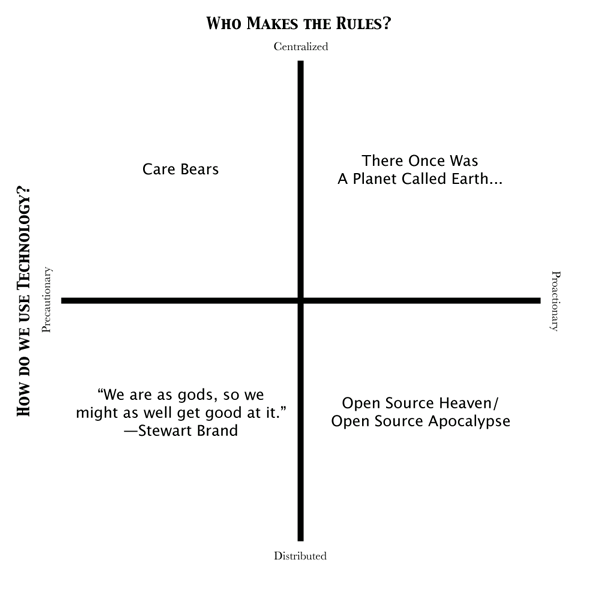
The first scenario, living in the combination of Centralized rule-making and
Precautionary technology use, is "Care Bears." The name refers to online games
in which players are prevented by the game rules from attacking each other. For
players who want no controls, the rules are overly-restrictive and remove the
element of surprise and innovation; for players who just want an enjoyable
experience, the rules are a welcome relief.
In this scenario, then, top-down rule-making with an emphasis on prevention of
harm comes to slow overall rates of molecular manufacturing progress. The result
is a world where nanotechnology-derived solutions are harder to come by, but one
where nanotechnology-derived risks are less likely, as well. This is something
of a baseline scenario for people who believe that regulation, licensing, and
controls on research and development are ultimately good solutions for avoiding
disastrous outcomes. The stability of the scenario, however, depends upon both
how well the top-down controls work, and whether emerging
capabilities of molecular manufacturing tempt some people or states to grab
greater power. If this scenario breaks, it could easily push into the
lower/right world.
The second scenario, combining Centralized rule-making and Proactionary
technology use, is "There Once Was A Planet Called Earth..." The name sets out
the story fairly concisely: competition between centralized powers seeking to
adopt the most powerful technologies as quickly as possible -- whether for
benign or malignant reasons -- stands a very strong likelihood of leading to a
devastating conflict. For me, this is the scenario most likely to lead to a bad
outcome.
Mutually-assured global destruction is not the only outcome, but the probable
path out of this scenario is a shift towards greater restrictions and controls.
This could happen because people see the risks and act accordingly, but is more
likely to happen because of an accident or conflict that brings us to the brink
of disaster. In such a scenario, increasing restrictions (moving from
proactionary to precautionary) are more likely than increasing freedom (moving
from centralized to distributed).
The third scenario, combining Distributed rule-making and Proactionary
technology use, is "Open Source Heaven/Open Source Apocalypse." The name
reflects the two quite divergent possibilities inherent in this scenario: one
where the spread of user knowledge and access to molecular manufacturing
technologies actually makes the world safer by giving more people the ability to
recognize and respond to accidents and threats, and one where the spread of
knowledge and access makes it possible for super-empowered angry individuals to
unleash destruction without warning, from anywhere.
My own bias is towards the "Open Source Heaven" version, but I recognize the
risks that this entails. We wouldn't last long if the knowledge of how to make a
device that would blow up the planet with a single button-push became
widespread, and some of the arguments around the destructive potential of
late-game molecular manufacturing seem to approach that level of threat.
Conversely, it's not hard to find evidence that open source knowledge and access
tends to offer greater long-term safety and stability than does a closed
approach, and that insufficiently-closed projects leaking out to interested and
committed malefactors (but not as readily to those who might help to defend
against them) offers the risks of opening up without any of the benefits.
Finally, the fourth scenario, combining Distributed rule-making and
Precautionary technology use, is "We Are As Gods, So We Might As Well Get Good
At It." Stewart Brand used that as an opening line for his
Whole
Earth Catalogs, reflecting his sense that the emerging potential of new
technologies and social models gave us -- as human beings -- access to far
greater capabilities than ever before, and that our survival depended upon
careful, considered examination of the implications of this fact.
In this world, the widespread knowledge of and access to molecular manufacturing
technologies gives us a chance to deal with some of the more pressing big
problems we as a planet face -- extreme poverty, hunger, global warming, and the
like -- in effect allowing us breathing room to take stock of what kind of
future we'd like to create. Those individuals tempted to use these capabilities
for personal aggrandizement have to face a knowledgeable and empowered populace,
as do those states seeking to take control away from the citizenry. This is,
admittedly, the least likely of the four worlds, sadly.
But you don't have to take my word for it. This "four box" structure doesn't
offer predictions, but a set of lenses with which to understand possible
outcomes and the strategies that might be employed to reach or avoid them. The
world that will emerge will undoubtedly have elements of all four scenarios, as
different nations and regions are likely to take different paths. The main
purpose of this structure is to prompt discussion about what we can do now to
push towards the kind of world in which we'd want to live, and to thrive.
C-R-Newsletter #58:
October 31, 2007
Productive
Nanosystems Conference
The Nanofactory
Ecosystem
Scenario
Publication Plans
Keeping Tabs on
China
Monstrous Hybrids
Alive
Feynman Prizes
Awarded
Foresight Vision
Weekend
Guest Science
Essay: Exploring the Productive Nanosystems Roadmap
Every month
is full of activity for CRN. To follow the latest happenings on a daily basis,
be sure to check our
Responsible Nanotechnology weblog.
==========
Productive Nanosystems Conference
One of the biggest events of the year in advanced nanotechnology was a recent
conference titled “Productive
Nanosystems: Launching the Technology Roadmap.” The event, organized by the
Society of Manufacturing Engineers, the Foresight Nanotech Institute, and
Battelle, was reported extensively -- almost minute-by-minute -- by CRN's Chris
Phoenix on our blog, and is also the subject of this month’s guest science essay
by Damian Allis (see below). Chris. For your convenience we’ve created
a listing of the superb coverage that Chris provided, including every
presentation at the conference.
The Nanofactory Ecosystem
We’re pleased to report that CRN's latest monthly column for the popular
Nanotechnology Now
web portal was authored by our new Director of
Impacts Analysis, Jamais Cascio. His article is titled "The
Nanofactory Ecosystem." Here is the abstract:
In addition to understanding the progress of nanotechnology
toward building atomically-precise desktop manufacturing systems --
nanofactories -- we also need to consider the infrastructure needed to
sustain that new technology paradigm. What sort of "ecosystem" might spring up
around nanofactories?
We hope you'll read
all our
columns, offer feedback, and tell others about them too.
Scenario Publication Plans
CRN is excited to have an agreement with
Nanotechnology
Perceptions, a peer-reviewed academic journal published by Switzerland's
Collegium Basilea, to begin releasing our
nanotechnology scenario series starting with their November 2007 issue. They
will publish two scenarios in that first issue, then follow with two more in
their March 2008 issue, and conclude with the remaining four scenarios in July
2008. Each issue also will include at least one commentary article from a
"European perspective." Simultaneous with the November 2007 issue of the
journal, all eight of our scenarios will be posted online at the
Nanowerk.com
site, where they also will host a discussion space for readers. We're quite
pleased with both of these arrangements; together they will help us to reach a
wide audience for this important project.
Keeping Tabs on China
At CRN, we spend a lot of time thinking and writing
about China, and we believe with good reason. It's common to hear the last
100 years referred to as "The American Century," and many observers now suggest
that the next 100 years eventually will be known as "The Chinese Century."
Of course, a lot could happen to change that outcome. For one thing, China faces
huge internal and external challenges on its path to global supremacy. For
another, the United States is still the preeminent superpower in both economic
and military terms and is likely to remain so for some time.
But in looking outward over the next several decades, it's hard to conceive a
plausible scenario of world development that does not include China in some
capacity. So, as we try to envision how, where, and when molecular manufacturing
will emerge and what its implications will be, we
must include China in our calculations of context.
READ MORE…
Monstrous Hybrids Alive
What's the most important book you could read that's not about science or
technology to gain a better understanding of CRN's work?
One strong candidate would be
Systems of Survival
by the late great social scientist Jane Jacobs. Although the book itself is not
especially readable (our “Three Systems” paper
includes the most important stuff), her ideas are profound.
Another book we've frequently recommended is Jim Garrison's
America as Empire: Global
Leader or Rogue Power? It offers a compelling review of previous
historical empires, their rise and fall, and compares them with the U.S. today.
Most relevant to CRN's work is Garrison's prescription for something he calls
network democracy.
Now, we may have a third title to add to this short list:
The Shock Doctrine: The Rise
of Disaster Capitalism by Naomi Klein. I don't have the book yet, but
from what I've heard it looks like a must-read, with a lot to say about the
unstable global future into which molecular manufacturing may emerge in the next
decade or two.
READ MORE…
Feynman Prizes Awarded
Every year, the Foresight Institute awards prizes to leaders in research,
communication and study in the field of nanotechnology. Prizes are conferred on
individuals whose work in research, communication and study are moving society
toward the ultimate goal of atomically-precise manufacturing.
This year's
winners are:
Theory Prize - David Leigh, University of Edinburgh, UK
Experimental Prize - Fraser Stoddart, UCLA
Communication Prize - Robert A Freitas Jr., Institute for Molecular
Manufacturing
Distinguished Student Prize - Fung-Suong Ou, Rice University
Congratulations to all!
Foresight Vision Weekend
Previous editions of the annual fall conference presented by the Foresight
Nanotech Institute have been open only to their "senior associates." But this
year, they're opening up the event to related groups, including people involved
with CRN. It's got a wide-open format this time too (it’s described as an
“un-conference”) with a very broad topic list. For more information on the
November 3-4 event in Sunnyvale, California,
click here.
Guest Science Essay: Exploring the Productive Nanosystems Roadmap
Damian Allis, Research Professor of Chemistry at Syracuse University and Senior
Scientist for Nanorex, Inc.
What follows is a brief series of notes and observations about the
Roadmap Conference,
some of the activities leading up to it, and a few points about the state of
some of the research that the Roadmap is hoping to address. All views expressed
are my own and not necessarily those of other Roadmap participants,
collaborators, my affiliated organizations (though I hope to not straddle that
fine line between "instigation" and "inflaming" in anything I present below).
Some Opening Praise for Foresight
There are, basically, three formats for scientific conferences. The first is
discipline-intensive, where everyone attending needs no introduction and
certainly needs no introductory slides (see the division rosters at most any
National ACS conference). The
only use of showing an example of
Watson-Crick base pairing
at a DNA nanotechnology conference of this format is to find out who found the
most aesthetically-pleasing image on "the Google."
There is the middle ground, where a single conference will have multiple
sessions divided into half-day or so tracks, allowing the carbon nanotube
chemists to see work in their field, then spend the rest of the conference
arguing points and comparing notes in the hotel lobby while the DNA scientists
occupy the conference room. The
FNANO
conference is of a format like this, which is an excellent way to run a
conference when scientists dominate the attendee list.
Finally, there is the one-speaker-per-discipline approach, where introductory
material consumes roughly 1/3 of each talk and attendees are given a taste of a
broad range of research areas. Such conferences are nontrivial to organize for
individual academics within a research plan but are quite straightforward for
external organizations with suitable budgets to put together.
To my mind, Foresight
came close to perfecting this final approach for nanoscience over the course of
its annual Conferences on Molecular Nanotechnology. Much like the organizational
Roadmap meetings and the Roadmap conference itself, these Foresight conferences
served as two-day reviews of the entire field of nanoscience by people directly
involved in furthering the cause. In my own case, research ideas and
collaborations were formed that continue to this day that I am sure would not
have otherwise. The attendee lists were far broader than the research itself,
mixing industry (the people turning research into products), government (the
people turning ideas into funding opportunities), and media (the people bringing
new discoveries to the attention of the public). Enough cannot be said about the
use of such broad-based conferences, which are instrumental in endeavors to
bring the variety of research areas currently under study into a single focus,
such as in the form of a technology Roadmap.
Why A "Productive Nanosystems" Roadmap?
The semiconductor industry
has its Roadmap. The
hydrogen storage community has its Roadmap. The
quantum computing and
cryptography
communities have their Roadmaps. These are major research and development
projects in groundbreaking areas that are not in obvious competition with one
another but see the need for all to benefit from all of the developments within
a field (in spirit, anyway). How could a single individual or research group
plan 20 years into the future (quantum computing) or plan for the absolute limit
of a technology (semiconductor)?
The
Technology Roadmap for Productive Nanosystems falls into the former
category, an effort to as much take a snapshot of current research and very
short-term pathways towards nanosystems in general as it is to begin to plot
research directions that take advantage of the continued cross-disciplinary
efforts now begun in National Labs and large research universities towards
increasing complexity in nanoscale study.
On one far end of the spectrum, the "productive nanosystem" in all of its
atomically-precise glory as envisioned by many forward-thinking scientists is a
distant, famously debated, and occasionally ridiculed idea that far exceeds our
current understanding within any area of the physical or natural sciences. Ask
the workers on the first Model T assembly line how they expected robotics to
affect the livelihoods and the productivity of the assembly lines of their
grandchildren's generation, and you can begin to comprehend just how
incomprehensible the notion of a fully developed desktop nanofactory or medical
nanodevice is even to many people working in nanoscience.
On the other end of the spectrum (and the primary reason, I think, in molecular
manufacturing), it seems rather narrow-minded and short-sighted to believe that
we will never be able to control the fabrication of matter at the atomic scale.
The prediction that scientists will still be unable in 50 years to abstract a
carbon atom from a diamond lattice or build a computer processing unit by
placing individual atoms within an insulating lattice of other atoms seems
absurd. That is, of course, not to say that
molecular
manufacturing-based approaches to the positional control of individual atoms
for fabrication purposes will be the best approach to generating various
materials, devices, or complicated nanosystems (yes, I'm in the field and I
state that to be a perfectly sound possibility).
To say that we will never have that kind of control, however, is a bold
statement that assumes scientific progress will hit some kind of technological
wall that, given our current ability to manipulate individual hydrogen atoms
(the smallest atoms we have to work with) with positional control on atomic
lattices, seems to be sufficiently porous that atomically precise manufacturing,
including the mechanical approaches envisioned in molecular manufacturing
research, will continue on undaunted. At the maturation point of all possible
approaches to atomic manipulation, engineers can make the final decision of how
best to use the available technologies. Basically and bluntly, futurists are
planning the perfect paragraph in their heads while researchers are still
putting the keyboard together. That, of course, has been and will always
be the case at every step in human (and other!) development. And I mean that in
the most positive sense of the comparison. Some of my best friends are futurists
and provide some of the best reasons for putting together that keyboard in the
first place.
Perhaps a sea change over the next ten years will involve molecular
manufacturing antagonists beginning to agree that "better methods exist for
getting A or B" instead of now arguing that "molecular manufacturing towards A
and B is a waste of a thesis."
That said, it is important to recognize that the Technology Roadmap for
Productive Nanosystems is not a molecular manufacturing Roadmap, rather a
Roadmap that serves to guide the development of nanosystems capable of atomic
precision in the manufacturing processes of molecules and larger systems. The
difference is largely semantic, though, founded in the descriptors of molecular
manufacturing as some of us have come to know and love it.
Definitions!
If we take the working definitions from the Roadmap...
Nanosystems are interacting nanoscale structures, components, and
devices.
Functional nanosystems are nanosystems that process material, energy, or
information.
Atomically precise structures are structures that consist of a specific
arrangement of atoms.
Atomically precise technology (APT) is any technology that exploits
atomically precise structures of substantial complexity.
Atomically precise functional nanosystems (APFNs) are functional
nanosystems that incorporate one or more nanoscale components that have
atomically precise structures of substantial complexity.
Atomically precise self-assembly (APSA) is any process in which
atomically precise structures align spontaneously and bind to form an atomically
precise structure of substantial complexity.
Atomically precise manufacturing (APM) is any manufacturing technology
that provides the capability to make atomically precise structures, components,
and devices under programmable control.
Atomically precise productive nanosystems (APPNs) are functional
nanosystems that make atomically precise structures, components, and devices
under programmable control, that is, they are advanced functional nanosystems
that perform atomically precise manufacturing.
The last definition is the clincher. It combines atomic precision (which means
you know the properties of a system at the atomic level and can, given the
position of one atom, know absolutely about the rest of the system) and
programmable control (meaning information is translated into matter assembly).
Atomic precision does not mean "mostly (7,7) carbon nanotubes of more-or-less 20
nm lengths," "chemical reactions of more than 90% yield," "gold nanoparticles of
about 100 nm diameters," or "molecular nanocrystals with about 1000 molecules."
That is not atomic precision, only our current level of control over
matter. I am of the same opinion as
J. Fraser Stoddart,
who described the state of chemistry (in his
Feynman
Experimental Prize lecture) as "an 18 month old" learning the words of
chemistry but unable to speak the short sentences of supramolecular assembly and
simple functional chemical systems, make paragraphs of complex devices from
self-assembling or directed molecules, or the novels that approach the scales of
nanofactories, entire cells, or whatever hybrid system first can be pointed to
by all scientists as a first true productive nanosystem.
Plainly, there is no elegant, highly developed field in
the physical or natural sciences. None. Doesn't exist, and anyone arguing
otherwise is acknowledging that progress in their field is dead in the water.
Even chiseled stone was state-of-the-art at one point.
The closest thing we know of towards the productive nanosystem end is the
ribosome, a productive nanosystem that takes information (mRNA) and turns it
into matter (peptides) using a limited set of chemical reactions (amide bond
formation) and a very limited set of building materials (amino acids) to make a
very narrow range of products (proteins) which just happen to, in concert, lead
to living organisms. The ribosome serves as another important example for the
Roadmap. Atomic precision in materials and products does not mean
absolute positional knowledge in an engineering, fab facility manner. Most
cellular processes do not require knowledge of the location of any component,
only that those components will eventually come into Brownian-driven contact.
Molecular manufacturing proponents often point to the ribosome as "the example"
among reasons to believe that engineered matter is possible with atomic
precision. The logical progression from ribosome to
diamondoid nanofactory, if that progression exists on a well-behaved
wavefunction (continuous, finite -- yeesh-- with pleasant first derivatives), is
a series of substantial leaps of technological progress that molecular
manufacturing opponents believe may/can/will never be made. Fortunately, most of
them are not involved in research towards a molecular manufacturing end and so
are not providing examples of how it cannot be done, while those of us doing
molecular manufacturing research are both showing the potential, and the
potential pitfalls, all the while happy to be doing the dirty work for opponents
in the interest in pushing the field along.
It is difficult to imagine that any single discipline will contain within its
practitioners all of the technology and know-how to provide the waiting world
with a productive nanosystem of any kind. The synthetic know-how to break and
form chemical bonds, the supramolecular understanding to be able to predict how
surfaces may interact as either part of self-assembly processes or as part of
mechanical assembly, the systems design to understand how the various parts will
come together, the physical and quantum chemistry to explain what's actually
happening and recommend improvements as part of the design and modeling process,
the characterization equipment to follow both device assembly and manufacturing:
each of these aspects relevant to the assembly and operations of productive
nanosystems are, in isolation, areas of current research that many researchers
individually devote their entire lives to and that are all still very much in
development.
However, many branches of science are starting to merge and perhaps the first
formal efforts at systems design among the many disciplines are likely to be
considered the ACTUAL beginning of experimental nanotechnology. The
interdisciplinaritization (yes, made that one up myself) of scientific research
is being pushed hard at major research institutions by way of the development of
Research Centers, large-scale facilities that intentionally house numerous
departments or simply broad ranges of individual research. Like research efforts
into atomically precise manufacturing, the pursuit of interdisciplinary research
is a combination of bottom-up and top-down approaches, with the bottom-up effort
a result of individual researchers collaborating on new projects as ideas and
opportunities allow and the top-down efforts a result of research universities
funding the building of Research Centers and, as an important addition, state
and federal funding agencies providing grant opportunities supporting
multi-disciplinary efforts and facilities.
But is that enough? Considering all of the varied research being performed in
the world, is it enough that unionized cats are herding themselves into small
packs to pursue various ends, or is there some greater benefit to having a
document that not only helps to put their research into the context of the
larger field of all nanoscience research, but also helps them draw connections
to other efforts? Will some cats choose to herd themselves when presented with a
good reason?
The Roadmap is not only a document that describes approaches to place us on the
way to Productive Nanosystems. It is also a significant summary of current
nanoscale research that came out of the three National Lab Working Group
meetings. As one might expect, these meetings were very much along the lines of
a typical Foresight Conference, in which every half hour saw a research
presentation on a completely different subject that, because each provided a
foundation for the development of pathways and future directions, were found to
have intersections. The same is true of the research and application talks at
the official SME
release conference. It's almost a law of science. Put two researchers into a
room and, eventually, a joint project will emerge.
On to the Conference
In describing my reactions to the conference, I'm going to skip many, many
details, inviting you, the reader, to check out the Roadmap proper when it's
made available online and, until then, to read through Chris Phoenix's
live-blogging.
As for what I will make mention of...
Pathways Panel
A panel consisting of Schafmeister, Randall, Drexler, and Firman (with Von Ehr
moderating) from the last section of the first day covered major pathway
branches presented in the Roadmap, with all the
important points caught by Chris Phoenix's QWERTY mastery.
I'll spare the discussion, as it was covered so well by Chris, but I will point
out a few important take-homes:
Firman said, "Negative results are a caustic subject... while fusing proteins,
sometimes we get two proteins that change each other's properties. And that's a
negative result, and doesn't get published. It shouldn't be lost." Given the
survey nature of the types of quantum chemical calculations being performed to
model tooltip designs that might be used for the purposes of mechanosynthesis
(molecular manufacturing or otherwise),
Drexler,
Freitas,
Merkle, and
myself spend
considerable time diagnosing failure modes and possibly unusable molecular
designs, making what might otherwise be "negative results" important additions
to our respective design and analysis protocols. Wired readers will note
that Thomas Goetz covered this topic ("Dark Data") and some web efforts to make
this type of data available in Issue 15.10.
I loved the panel’s discussion of replication, long a point of great controversy
over concerns and feasibility. Drexler mentioned how his original notion of a
"replicator" as proposed in
Engines of Creation is obsolete for pragmatic/logistical reasons. But
the next comment was from Schafmeister, who, in his research talk, had proposed
something that performs a form of replication (yes, that's the experimental
chemist making the bold statement); it would be driven externally, but
nonetheless something someone could imagine eventually automating. Christian
also performed a heroic feat in his talk by presenting his own (admittedly, by
him) "science fiction" pathway for applying his own lab research to a far more
technically demanding end, something far down the road as part of his larger
research vision.
Randall, on the use of the Roadmap, said, "The value of the Roadmap will be
judged by the number of people who read it and try to use it. Value will
increase exponentially if we come back and update it." The nature of nanoscience
research is that six months can mean a revolution. I (and a few others at the
very first Working Group meeting) had been familiar with structural DNA
nanotechnology, mostly from having seen
Ned Seeman present
something new at every research talk (that is also a feat in the sciences, where
a laboratory is producing quick enough to always have results to hand off to the
professor in time for the next conference). The Rothemund
DNA Origami paper [PDF] was a turning point to many and made a profound
statement on the potential of DNA nanotech. I was amazed by it. Drexler's
discussions on the possibilities have been and continue to be contagious.
William Shih
mentioned that his research base changed fundamentally because of DNA Origami,
and seeing the complexity of the designs AND the elegance of the experimental
studies out of his group at the Roadmap Conference only cemented in my mind just
how fast a new idea can be extended into other applications. It would not
surprise me if several major advances before the first revision of the Roadmap
required major overhauls of large technical sections. At the very least, I hope
that scientific progress requires it.
Applications Panel
A panel consisting of Hall, Maniar, Theis, O'Neill (with Pearl moderating) from
the last section of the second day covered applications, with short-term and
very long-term visions represented on the panel (again,
all caught by Chris Phoenix).
For those who don't know him,
Josh Hall was the wildcard of the applications panel, both for his far more
distant contemplations on technology than otherwise represented at the
conference and for his exhaustive historical perspective (he can synthesize
quite a bit of tech history and remind us just how little we actually know given
the current state of technology and how we perceive it; O'Neill mentioned this
as well, see below). Josh is far and away the most enlightening and entertaining
after-dinner raconteur I know. As a computer scientist who remembers wheeling
around hard drives in his graduate days, Josh knows well the technological
revolutions within the semiconductor industry and just how difficult it can be
for even industry insiders to gauge the path ahead and its consequences on
researchers and consumers.
Papu made an interesting point I'd not thought of before. While research labs
can push the absolute limits of nanotechnology in pursuit of new materials or
devices, manufacturers can only make the products that their facilities, or
their outsourcing partner facilities, can make with the equipment they have
available. A research lab antenna might represent a five-year leap in the
technology, but it can’t make it into today's mobile phone if the fab facility
can't churn it out in its modern
6 Sigma
manifestation.
Nanoscience isn't just about materials, but also new equipment for synthesis and
characterization, and the equipment for that is expensive in its first few
generations. While it’s perhaps inappropriate to refer to "consumer grade"
products as the "dumbed down" version of "research grade" technologies,
investors and conspiracy theorists alike can take comfort in knowing that there
really is "above-level" technology in laboratories just hoping the company lasts
long enough to provide a product in the next cycle.
O'Neill said, "To some of my friends, graphite epoxy is just black aluminum."
This comment was in regards to how a previous engineering and technician
generation sees advances in specific areas relative to their own mindset and not
as part of continuing advancements in their fields. It's safe to say that we all
love progress, but many fear change. The progress in science parallels that in
technology, and the ability to keep up with the state-of-the-art, much less put
it into practice as Papu described, is by no means a trivial matter. Just as
medical doctors require recertification, scientists must either keep up with
technology or simply see their efforts slow relative to every subsequent
generation. Part of the benefit of interdisciplinary research is that the
expertise in a separate field is provided automatically upon collaboration.
Given the time to understand the physics and the cost of equipment nowadays,
most researchers are all too happy to pass off major steps in development to
someone else.
Closing Thoughts
Non-researchers know the feeling. We've all fumbled with a new technology at one
point or another, be it a new cell phone or a new (improved?) operating system,
deciding to either "learn only the basics" or throw our hands up in disgust.
Imagine having your entire profession changed from the ground up or, even worse,
having your profession disappear because of technology. Research happening today
in nanoscience will serve a disruptive role in virtually all areas of technology
and our economy. Entire industries, too. Can you imagine the first catalytic
system that effortlessly turns water into hydrogen and oxygen gas? If filling
the tank of your jimmied VW ever means turning on your kitchen spigot, will your
neighborhood gas station survive selling peanut M&M's
and Snapple at ridiculous prices?
C-R-Newsletter #57: September 29, 2007
CRN Leadership Expands
A
Successful Nano-Bio Conference
Scenario
Publication Plans
Nanoethics
Questions
CRN Goes to
Hoboken
Journey vs.
Destination
Live-Blogging
Productive Nanosystems
Feature
Essay:
Levels of Nanotechnology Development
Every month
is full of activity for CRN. To follow the latest happenings on a daily basis,
be sure to check our
Responsible Nanotechnology weblog.
==========
CRN
Leadership Expands
The Center
for Responsible Nanotechnology is adding two new
members to its leadership team. Jamais Cascio will become CRN’s Director of
Impacts Analysis, and Jessica Margolin will take on the role of Director of
Research Communities, effective October 1, 2007. CRN co-founder
Chris Phoenix will begin his scheduled sabbatical
in October. Co-founder Mike Treder will continue to
serve as Executive Director of CRN.
“I’ve been
looking forward to this opportunity for some time,” said Phoenix. “With growing
recognition about the importance of molecular manufacturing, with Jamais and
Jessica, two extremely talented people, coming on board, and with Mike’s ongoing
leadership, I feel comfortable taking a sabbatical.”
Jamais
Cascio is a writer, blogger and futurist covering the intersection of emerging
technologies and cultural transformation. He speaks about future scenarios
around the world and his essays about technology and society have appeared in a
variety of print and online publications. He is a fellow at the
Institute for Ethics and Emerging
Technologies, as well as a research affiliate at the
Institute for the Future. He
also works on a variety of independent projects including serving as a lead
author of the recent
Metaverse Roadmap Overview report.
“I’ve
admired CRN’s work for a long time,” said Cascio, “and in recent months I’ve
become more actively involved. Now I’m extremely pleased to be joining the team
in a leadership capacity.”
In 2003,
Cascio co-founded
WorldChanging.com, a Web site dedicated to finding and calling attention to
models, tools, and ideas for building a ‘bright green’ future. Cascio authored
nearly 2,000 articles during his time at WorldChanging, looking at topics such
as energy and the environment, global development, open-source technologies, and
catalysts for social change. In 2006, he started
OpenTheFuture.com as his
online home.
Jessica
Margolin is an entrepreneur who consults in the area of purposeful conversations
and messaging systems. Her professional background includes industry roles in
financial analysis, business development, organizational design, and marketing
strategy and communications; her education includes an MS in Materials Science
in the area of nanotechnology, and an MBA.
“It's
important to ensure all voices are heard during periods of profoundly rapid
scientific innovation,” said Margolin. “Many nanoscale technologies are poised
to be disruptive, and CRN focuses on what is potentially the most disruptive of
all. I look forward to accelerating the development of the community surrounding
CRN's work.”
Currently a
research affiliate at Institute
for the Future, Margolin synthesizes her
professional
experience in the financial and internet industries as well as her
philanthropic work to address problems concerning the design of organizations,
institutions, and communities.
“I’m
ecstatic about the opportunity to work closely with both Jamais and Jessica as
we move forward in the important cause of ensuring safe development and
responsible use of advanced nanotechnology,” said Treder.
A Successful Nano-Bio Conference
From September 10-12, 2007,
CRN was proud to welcome attendees and speakers to our first conference --
"Challenges &
Opportunities: The Future of Nano &
Bio Technologies” -- hosted and co-organized in Tucson, Arizona, by
World Care.
We filled
three days with compelling speakers, panel discussions and novel interactive
collaborations, plus highly enjoyable social hours in the evening. Most of the
conference presentations have been posted online
for free download, and we’ve also offered
short reviews and commentaries on our blog.
To really
get a feel for the content and flow of the event, read the outstanding live blog
coverage provided by Michael Anissimov at
Accelerating Future and by Simone Syed for the
Frontier Channel. Great thanks to all who participated!
Scenario Publication Plans
CRN is pleased to have an agreement with
Nanotechnology
Perceptions, a peer-reviewed academic journal published by Switzerland's
Collegium Basilea, to begin releasing our
nanotechnology scenario series starting with their November 2007 issue. They
will publish two scenarios in that first issue, then follow with two more in
their March 2008 issue, and conclude with the remaining four scenarios in July
2008. Each issue also will include at least one commentary article from a
"European perspective." Simultaneous with the November 2007 issue of the
journal, all eight of our scenarios will be posted online at the
Nanowerk.com
site, where they also will host a discussion space for readers. We're quite
pleased with both of these arrangements; together they will help us to reach a
wide audience for this important project.
Nanoethics Questions
Just what is nanoethics, and why does it matter? That's a
question posed in the Spring 2007 issue of The New Atlantis. Adam Keiper,
the journal's editor, wrote a long article titled "Nanoethics
as a Discipline?" in which he challenged the validity of the field as a
whole and complained specifically about CRN's "many simplistic political and
social assumptions."
CRN wrote a
lengthy rebuttal pointing out the difficulty of stretching towards
understanding in areas where prior work is scant, if it exists at all. At this
stage, we're not ready to go into finer detail with either our analyses or
proposed solutions. Our task for now is to raise awareness of these issues and
to stimulate more comprehensive work by other groups, especially those with
deeper expertise in specific areas.
We also emphatically rejected Keiper’s intimation that because
the future is unknowable, it is therefore uninteresting or unworthy of
speculative exploration. Indeed, it is because we cannot say for sure how
nanotechnology will evolve and how it will affect society that we feel the need
to provoke such discussions. CRN will continue to work on forecasting the future
of nanotechnology, on gaining the facts, on defining our values, and on shaping
politically realistic solutions that give us the best hope for a safe and
responsible world of tomorrow.
Others also had strong responses to Keiper’s provocative article,
including numerous
nanoethics professors and best-selling author David Brin, who wrote a
guest commentary for CRN.
CRN Goes to Hoboken
A few weeks
ago, CRN Executive Director Mike Treder traveled across the Hudson River to
Hoboken, New Jersey, where he presented a seminar on the future of
nanotechnology to graduate students and faculty at
Stevens Institute of
Technology, one of the few universities to offer a
graduate program in
nanotechnology.
Mike said he
was impressed to learn, during sit-down sessions with professors and post-grad
students, about the remarkable work being done at Stevens. It is an institution
on the cutting edge of science and technology, and they show a keen interest in
understanding more about the social implications of their technological work.
Journey vs. Destination
CRN's latest
monthly column for the popular
Nanotechnology Now
web portal has been posted. The current article is titled "Nanotechnology:
Journey vs. Destination" -- here is the abstract:
Nanotechnology has acquired several distinct meanings over the last few
decades. Its development has been marked by this confusion, which has led to
concerns from one field of nanotechnology, molecular manufacturing, being
applied to other fields. As all fields of nanotechnology continue to develop,
molecular manufacturing will reach a point where it is able to accelerate the
other fields.
We hope
you'll read
all our
columns, offer feedback, and tell others about them too.
Live-Blogging Productive Nanosystems
“Productive
Nanosystems: Launching the Technology Roadmap” is the title of an exciting
conference coming soon to Arlington, Virginia (USA), organized by the Society of
Manufacturing Engineers, the Foresight Nanotech Institute, and Battelle. CRN's
Chris Phoenix is planning to attend the October 9-10 event and to "live blog"
his observations for us.
SPECIAL
OFFER: All C-R-Newsletter subscribers are eligible to receive the discounted
member rate -- a $200 savings! When
registering for the conference, enter priority code 07CF308 and member
number 270270 to receive the member rate.
Feature
Essay:
Levels of Nanotechnology Development
Chris
Phoenix, Director of Research, Center for Responsible Nanotechnology
Nanotechnology capabilities have been improving rapidly. More different things
can be built, and the products can do more than they used to. As nanotechnology
advances, CRN continually is asked: Why do we focus only on molecular
manufacturing, when there's important stuff already being done? This essay will
put the various levels of nanotechnology in perspective, showing where molecular
manufacturing fits on a continuum of development -- quite far advanced in terms
of capabilities. Along the way, this will show which kinds of nanotechnology
CRN's concerns apply to.
For another perspective on
nanotechnology development, it's worth reading the section on "The Progression
of Nanotechnology" (pages 3-6) from a
joint committee economic study [PDF] for the U.S. House of Representatives.
It does not divide nanotech along exactly the same lines, but it is reasonably
close, and many of the projections echo mine. That document is also an early
source for the NSF's division of nanotechnology into
four
generations.
The development arc of nanotechnology
is comparable in some ways to the history of computers. Ever since the abacus
and clay tablets, people have been using mechanical devices to help them keep
track of numbers. Likewise, the ancient Chinese reportedly used nanoparticles of
carbon in their ink. But an abacus is basically a better way of counting on your
fingers; it is not a primitive computer in any meaningful sense. It only
remembers numbers, and does not manipulate them. But I am not going to try to
identify the first number-manipulator; there are all sorts of ancient
distance-measuring carts, timekeeping devices, and astronomical calculators to
choose from. Likewise, the early history of nanotechnology will remain shrouded
in myth and controversy, at least for the purposes of this essay.
The first computing devices in
widespread use were probably mechanical adding machines, 19th century cash
registers, and similar intricate contraptions full of gears. These had to be
specially designed and built, a different design for each different purpose.
Similarly, the first nanotechnology was purpose-built structures and materials.
Each different nanoparticle or nanostructure had a particular set of properties,
such as strength or moisture resistance, and it would be used for only that
purpose. Of course, a material might be used in many different products, as a
cash register would be used in many different stores. But the material, like the
cash register, was designed for its specialized function.
Because purpose-designed materials are
expensive to develop, and because a material is not a product but must be
incorporated into existing manufacturing chains, these early types of
nanotechnology are not having a huge impact on industry or society.
Nanoparticles are, for the most part, new types of industrial chemicals. They
may have unexpected or unwanted properties; they may enable better products to
be built, and occasionally even enable new products; but they are not going to
create a revolution. In Japan, I saw an abacus used at a train station ticket
counter in the early 1990's; cash registers and calculators had not yet
displaced it.
The second wave of computing devices
was an interesting sidetrack from the general course of computing. Instead of
handling numbers of the kind we write down and count with, they handled
quantities -- fuzzy, non-discrete values, frequently representing physics
problems. These analog computers were weird and arcane hybrids of mechanical and
electrical components. Only highly trained mathematicians and physicists could
design and use the most complex of these computers. They were built this way
because they were built by hand out of expensive components, and it was worth
making each component as elegant and functional as possible. A few vacuum tubes
could be wired up to add, subtract, multiply, divide, or even integrate and
differentiate. An assemblage of such things could do some very impressive
calculations -- but you had to know exactly what you were doing, to keep track
of what the voltage and current levels meant and what effect each piece would
have on the whole system.
Today, nanotechnologists are starting
to build useful devices that combine a few carefully-designed components into
larger functional units. They can be built by chemistry, self-assembly, or
scanning probe microscope; none of these ways is easy. Designing the devices is
not easy. Understanding the components is somewhat easy, depending on the
component, but even when the components appear simple, their interaction is
likely not to be simple. But when your technology only lets you have a few
components in each design, you have to get the most you can out of each
component. It goes without saying that only experts can design and build such
devices.
This level of nanotechnology will
enable new applications, as well as more powerful and effective versions of some
of today's products. In a technical sense, it is more interesting than
nanoparticles -- in fact, it is downright impressive. However, it is not a
general-purpose technology; it is far too difficult and specialized to be
applied easily to more than a tiny fraction of the products created today. As
such, though it will produce a few impressive breakthroughs, it will not be
revolutionary on a societal scale.
It is worth noting that some observers,
including some nanotechnologists, think that this will turn out to be the most
powerful kind of nanotechnology. Their reasoning goes something like this:
Biology uses this kind of elegant highly-functional component-web. Biology is
finely tuned for its application, so it must be doing things the best way
possible. And besides, biology is full of elegant designs just waiting for us to
steal and re-use them. Therefore, it's impossible to do better than biology, and
those who try are being inefficient in the short term (because they're ignoring
the existing designs) as well as the long term (because biology has the best
solutions). The trouble with this argument is that biology was not designed by
engineers for engineers. Even after we know what the components do, we will not
easily be able to modify and recombine them. The second trouble with the
argument is that biology is constrained to a particular design motif: linear
polymers modified by enzymes. There is no evidence that this is the most
efficient possible solution, any more than vacuum tubes were the most efficient
way to build computer components. A third weakness of the argument is that there
may be some things that simply can't be done with the biological toolbox. Back
when computers were mainly used for processing quantities representing physical
processes, it might have sounded strange to say that some things couldn't be
represented by analog values. But it would be more or less impossible to search
a billion-byte text database with an analog computer, or even to represent a
thousand-digit number accurately.
It may seem strange to take a circuit that could add two
high-precision numbers and rework it into a circuit that could add 1+1, so that
a computer would require thousands of those circuits rather than dozens. But
that is basically what was done by the designers of ENIAC, the famous early
digital computer. There were at least two or three good reasons for this. First,
the 1+1 circuit was not just high-precision, it was effectively infinite
precision (until a vacuum tube burned out) because it could only answer in
discrete quantities. You could string together as many of these circuits as you
wanted, and add ten- or twenty-digit numbers with infinite precision. Second,
the 1+1 circuit could be faster. Third, a computer doing many simple operations
was easier to understand and reprogram than a computer doing a few complex
operations. ENIAC was not revolutionary, compared with the analog computers of
its day; there were many problems that analog computers were better for. But it
was worth building. And more importantly, ENIAC could be improved by improving
just a few simple functions. When transistors were invented, they quickly
replaced vacuum tubes in digital computers, because digital computers required
fewer and less finicky circuit designs.
The third level of nanotechnology,
which is just barely getting a toehold in the lab today, is massively parallel
nano-construction via relatively large computer-controlled machines. For
example, arrays of tens of thousands of scanning probes have been built, and
these arrays have been used to build tens of thousands of micro-scale pictures,
each with tens of thousands of nano-scale dots. That's a billion features, give
or take an order of magnitude -- pretty close to the number of transistors on a
modern computer chip. That is impressive. However, a billion atoms would make an
object about the size of a bacterium; this type of approach will not be used to
build large objects. And although I can imagine ways to use it for
general-purpose construction, it would take some work to get there. Because it
uses large and delicate machines that it cannot itself build, it will be a
somewhat expensive family of processes. Nevertheless, as this kind of technology
improves, it may start to steal some excitement from the bio-nano approach,
especially once it becomes able to do atomically precise fabrication using
chemical reactions.
Massively parallel nano-construction
will likely be useful for building better computers and less expensive sensors,
as well as a lot of things no one has thought of yet. It will not yet be
revolutionary, by comparison with what comes later, but it starts to point the
way toward revolutionary construction capabilities. In particular, some
nano-construction methods, such as Zyvex's
Atomically Precise Manufacturing, might eventually be able to build their
improved versions of their own tools. Once computer-controlled
nano-fabrication can build improved versions of its own tools, it will start to
lead to the next level of nanotechnology: exponential manufacturing. But until
that point, it appears too primitive and limited to be revolutionary.
ENIAC could store the numbers it was
computing on, but the instructions for running the computation were built into
the wiring, and it had to be rewired (but not rebuilt) for each different
computation. As transistors replaced vacuum tubes, and integrated circuits
replaced transistors, it became reasonable for computers to store their own
programs in numeric form, so that when a different program was needed, the
computer could simply read in a new set of numbers. This made computing a lot
more efficient. It also made it possible for computers to help to compile their
own programs. Humans could write programs using symbols that were more or less
human-friendly, and the computer could convert those symbols into the proper
numbers to tell the computer what to do. As computers became more powerful, the
ease of programming them increased rapidly, because the symbolic description of
their program could become richer, higher-level, and more human-friendly. (Note
that, in contrast, a larger analog computer would be more difficult to program.)
Within a decade after ENIAC, hobbyists could learn to use a computer, though
computers were still far too expensive for hobbyists to own.
The fourth level of nanotechnology is
early exponential manufacturing. Exponential manufacturing means that the
manufacturing system can build most of its key components. This will radically
increase the throughput, will help to drive down the cost, and also implies that
the system can build improved versions of itself fairly quickly. Although it's
not necessarily the case that exponential manufacturing will use molecular
operations and molecular precision (molecular manufacturing), this may turn out
to be easier than making exponential systems work at larger scales. Although the
most familiar projections of molecular manufacturing involve highly advanced
materials such as carbon lattice (diamondoid), the first molecular manufacturing
systems likely will use polymers that are weaker than diamondoid but easier to
work with. Exponential manufacturing systems with large numbers of fabrication
systems will require full automation, which means that each operation will have
to be extremely reliable. As previous science
essays have discussed, molecular manufacturing appears to provide the
required reliability, since covalent bonding can be treated as a digital
operation. In the same way that the 1+1 circuit is more precise than the analog
adder, adding a small piece onto a molecule can be far more precise and reliable
than any currently existing manufacturing operation -- reliable enough to be
worth doing millions of times rather than using one imprecise bulk operation to
build the same size of structure.
Early exponential manufacturing will
provide the ability to build lots of truly new things, as well as computers far
in advance of today's. With molecular construction and rapid prototyping, we
will probably see breakthrough medical devices. Products may still be quite
expensive per gram, especially at first, since early processes are likely to
require fairly expensive molecules as feedstocks. They may also require some
self-assembly and some big machines to deal with finicky reaction conditions.
This implies that for many applications, this technology still will be building
components rather than products. However, unlike the cost per gram, the cost per
feature will drop extremely rapidly. This implies far less expensive sensors. At
some point, as products get larger and conventional manufacturing gets more
precise, it will be able to interface with molecular manufactured products
directly; this will greatly broaden the applications and ease the design
process.
The implications of even early
molecular manufacturing are disruptive enough to be interesting to CRN. Massive
sensor networks imply several new kinds of weapons, as do advanced medical
devices. General-purpose automated manufacturing, even with limitations, implies
the first stirrings of a general revolution in manufacturing. Machines working
at the nanoscale will not only be used for manufacturing, but in a wide variety
of products, and will have far higher performance
than larger machines.
In one sense, there is a continuum from
the earliest mainframe computers to a modern high-powered gaming console. The
basic design is the same: a stored-program digital computer. But several decades
of rapid incremental change have taken us from million-dollar machines that
printed payroll checks to several-hundred-dollar machines that generate
real-time video. A modern desktop computer may contain a million times as many
computational elements as ENIAC, each one working almost a million times as fast
-- and the whole thing costs thousands of times less. That's about fifteen
orders of magnitude improvement. For what it's worth, the functional density of
nanometer-scale components is eighteen orders of magnitude higher than the
functional density of millimeter-scale components.
Diamondoid
molecular manufacturing is expected to produce the same kind of advances
relative to today's manufacturing.
The implications of this level of
technology, and the suddenness with which it might be developed, have been the
focus of CRN's work since our founding almost five years ago. They cannot be
summarized here; they are too varied and extreme. We
hope you will learn more and join our efforts to prepare the world for this
transformative technology.
C-R-Newsletter #56: August 31, 2007
CRN
Conference Almost Here!
Scenarios Sneak Preview
Conference Live-Blogging
& Audiotaping
Scenario Publication
Plans
Nanotech Revolution
Challenges and Pitfalls
Productive Nanosystems
Event
Feature Essay: Limitations of
Early Nanofactory Products
Every month is full of activity for CRN.
To follow the latest happenings on a daily basis,
be sure to check our
Responsible Nanotechnology weblog.
==========
CRN Conference Almost Here!
The first major conference from CRN and
World Care --
“Challenges and Opportunities for the Future of Nano and Bio Technologies” -- is
just over a week away! We’ve got a great
lineup of presenters and we're busy
taking registrations.
Here are some of the speakers you’ll see at the conference:
 |
Vicki Chandler,
University of Arizona |
|
J. Storrs Hall,
Institute for Molecular Manufacturing |
|
Lisa Hopper, World
Care |
|
Gary Marchant,
Center for the Study of Law, Science, and Technology |
|
Jason McCoy,
Seawater Foundation |
|
Ralph Merkle,
Institute for Molecular Manufacturing |
|
Deborah Osborne,
Police Futurists International |
|
Chris Phoenix, CRN |
|
Ned Seeman, New York
University |
|
Tihamer Toth-Fejel,
General Dynamics |
|
Mike Treder, CRN |
|
Jim Von Ehr, Zyvex |
|
Brian Wang, Advanced
Nano |
This exciting conference, featuring three full days of
presentations and audience-involving discussions
along with a fourth day of area lab tours, is September 9–13 at the Radisson
Hotel and Suites in Tucson, Arizona. We hope to see you there! (See entries
below for additional details.)
Scenarios Sneak Preview
Over the last several months, CRN has pulled together more than 50 people from
six continents, with a range of backgrounds and points of view, to collaborate
in producing a series of professional-quality models of a world in which
molecular manufacturing becomes a reality. This is the CRN Task Force
Scenario Development Project, one of the most important
undertakings we have yet attempted.
Like to get a “sneak preview” of the eight alternate futures that we’ve
constructed? Attend our conference in Tucson (see entry
above), where we’ll make these stories available for review and debate for
the first time. It will be the initial public opportunity for assessing and
responding to the scenarios.
Conference Live-Blogging &
Audiotaping
We’re very pleased to announce that Michael Anissimov, proprietor of the popular
“Accelerating
Future” weblog, has volunteered to coordinate live-blogging of all sessions
at our upcoming Nano-Bio conference, and to produce
audiotape recordings of all conference presentations. The live-blogging will
enable those who can’t attend to keep up with what’s happening in real-time, and
the audio recordings will be made available online for free at some point after
the conference concludes. Our sincere thanks to Michael!
Scenario Publication Plans
CRN has reached an agreement with
Nanotechnology
Perceptions, a peer-reviewed academic journal published by Switzerland's
Collegium Basilea, to begin releasing our nanotechnology
scenario series starting with their November 2007 issue. They will publish
two scenarios in that first issue, then follow with two more in their March 2008
issue, and conclude with the remaining four scenarios in July 2008. Each issue
also will include at least one commentary article from a "European perspective."
Simultaneous with the November 2007 issue of the journal, all
eight of our scenarios will be posted online at the
Nanowerk.com
site, where they also will host a discussion space for readers. We're quite
pleased with both of these arrangements; together they will help us to reach a
wide audience for this important project.
Nanotech Revolution
CRN's latest monthly column for the popular
Nanotechnology Now web
portal has been posted. The current article is titled "Early
Products in the Nanotech Revolution." Here is the abstract:
Building complex products atom by atom with advanced
nanotechnology: if and when this is accomplished, the resulting applications
could radically transform many areas of human endeavor. Products for
transportation, recreation, communication, medical care, basic needs, military
support, and environmental monitoring -- all may be profoundly affected even
during the early stages of the coming nanotech "revolution."
We hope you'll read
all our
columns, offer feedback, and tell others about them too.
Challenges and Pitfalls
These early years of the 21st century already are a time of
rapid advances in science and technology. Every day brings news of startling
developments in fields such as genetic engineering, neuroscience, and
nanotechnology. So what will the near future actually bring us? Human
beings that glow in the dark, like our bioengineered pets? Robot servants?
Flying cars? Genuine artificial intelligence? Or something even more exotic?
There is good reason to believe that within the next 10 to
20 years, the most significant changes to society will go far beyond glowing
people or flying cars. Many of them may result from the introduction of
personal nanofactories, a powerful application of exponential
general-purpose molecular manufacturing, made possible by advanced
nanotechnology.
Above are the opening paragraphs of a new paper, "Challenges
and Pitfalls of Exponential Manufacturing," by Mike Treder and Chris
Phoenix, that we've just posted on our main website. It's a reprint of the
chapter we provided for the
recently published anthology, Nanoethics: The Ethical and Social
Implications of Nanotechnology, edited by Fritz Allhof, Patrick Lin, James
Moor, and John Weckert. We encourage you to
get the book or, at the very least, read our
contribution.
Productive Nanosystems Event
“Productive Nanosystems: Launching the Technology Roadmap” is the title of an
exciting conference coming up this fall in Arlington, Virginia (USA),
organized by the Society of Manufacturing Engineers, the Foresight Nanotech
Institute, and Battelle. CRN's Chris Phoenix is planning to attend and to "live
blog" the event for us.
SPECIAL OFFER:
All C-R-Newsletter subscribers are eligible to receive the discounted member
rate -- a $200 savings!
When registering for the conference, enter priority code 07CF308 and member
number 270270 to receive the member rate.
Feature Essay: Limitations of Early Nanofactory Products
Chris Phoenix, Director of Research, Center for Responsible Nanotechnology
Although molecular manufacturing and its products will be amazingly powerful,
that power will not be unlimited. Products will have several important physical
limitations and other technological limitations as well. It may be true, as
Arthur C. Clarke suggests, that "any sufficiently advanced technology is
indistinguishable from magic," but early molecular manufacturing
(diamondoid-based nanofactories) will not, by that definition, be sufficiently
advanced.
Molecular manufacturing is based on building materials by putting atoms together
using ordinary covalent bonds. This means that the strength of materials will be
limited by the strength of those bonds. For several reasons, molecular
manufacturing-built materials will be stronger than those we are used to. A
structural defect can concentrate stress and cause failure; materials built
atom-by-atom can be almost perfect, and the few remaining defects can be dealt
with by branched structures that isolate failures. By contrast, today's carbon
fiber is chock-full of defects, so is much weaker than it could be. Conventional
metallurgy produces metal that is also full of defects. So materials built with
molecular manufacturing could approach the strength of carbon nanotubes -- about
100 times stronger than steel -- but probably not exceed that strength.
Energy storage will be bulky and heavy. It appears that the best non-nuclear way
to store energy is via ordinary chemical fuel. In other words, energy storage
won't be much more compact than a tank of gasoline. Small nuclear energy
sources, on the order of 10-micron fuel particles, appear possible if the right
element is chosen that emits only easily-shielded particles. However, this would
be expensive, unpopular, and difficult to manufacture, and probably will be
pretty rare.
To make the most of chemical energy, a few tricks can be played. One (suggested
by
Eric Drexler in conversation) is building structures out of carbon that
store mechanical energy; springs and flywheels can store energy with
near-chemical density, because they depend on stretched bonds. After the
mechanical energy is extracted, the carbon can be oxidized to provide chemical
energy. As it happens, carbon oxidized with atmospheric oxygen appears to be the
most dense store of chemical energy. Of course, if the mechanical structures are
not oxidized, they can be recharged with energy from outside the device, in
effect forming a battery-like energy store with very high energy density
compared to today's batteries.
Another trick that can make the most of chemical energy stores is to avoid
burning them. If energy is converted into heat, then only a fraction of it can
be used to do useful work; this is known as the Carnot limit. But if the energy
is never thermalized -- if the atoms are oxidized in a fuel cell or in an
efficient mechanochemical system -- then the Carnot limit does not apply. Fuel
cells that beat the Carnot limit exist today.
For a lot more information about energy storage, transmission, and conversion,
see Chapter 6 of Nanomedicine I (available
online).
Computer power will be effectively unlimited by today's standards, in the sense
that few algorithms exist that could make efficient use of the computers
molecular manufacturing could build. This does not mean that computer capacity
will be literally unlimited. Conventional digital logic, storing information in
stable physical states, may be able to store a bit per atom. At that rate, the
entire Internet (about 2 petabytes) could be stored within a few human cells (a
few thousand cubic microns), but probably could not be stored within a typical
bacterium.
Of course, this does not take quantum computers into account. Molecular
manufacturing's precision may help in the construction of quantum computer
structures. Also, there may be arcane techniques that might store more than one
bit per atom, or do computation with sub-atomic particles. But these probably
would not work at room temperature. So for basic computer capacity, it's
probably reasonable to stick with the estimates found in Nanosystems: 1017
logic gates per cubic millimeter, and 1016 instructions per second
per watt. (A logic gate may require many more atoms than required to store a
bit.) These numbers are from Chapter 1 of Nanosystems (available
online).
It is not yet known what kinds of chemistry the first nanofactories will do.
Certainly they will not be able to do everything. Water, for example, is liquid
at room temperature, and water molecules will not stay where they are placed
unless the factory is operating at cryogenic temperatures. This may make it
difficult to manufacture things like food. (Building better greenhouses, on the
other hand, should be relatively straightforward.) Complicated molecules or
arcane materials may require special research to produce. And, of course, no
nanofactory will be able to convert one chemical element into another; if a
design requires a certain element, that element will have to be supplied in the
feedstock. The good news is that carbon is extremely versatile.
Sensors will be limited by basic physics in many ways. For example, a small
light-gathering surface may have to wait a long time before it collects enough
photons to make an image. Extremely small sensors will be subject to thermal
noise, which may obscure the desired data. Also, collecting data will require
energy to do computations. (For some calculations in this area, see
Nanomedicine I,
Chapter 4.)
Power supply and heat dissipation will have to be taken into account in some
designs. Small widely-separated systems can run at amazing power densities
without heating up their environment much. However, small systems may not be
able to store much fuel, and large numbers of small systems in close proximity
(as in some nanomedical applications) may still create heat problems. Large
(meter-scale) systems with high functional density can easily overwhelm any
currently conceived method of cooling. Drexler calculated that a
centimeter-thick slab of solid nanocomputers could be cooled by a special
low-viscosity fluid with suspended encapsulated ice particles. This is quite a
high-tech proposal, and Drexler's calculated 100 kW per cubic centimeter (with
25% of the volume occupied by coolant pipes) probably indicates the highest
cooling rate that should be expected.
The good news on power dissipation is that nanomachines may be extremely
efficient. Scaling laws imply high power densities and operating frequencies
even at modest speeds -- speeds compatible with >99% efficiency. So if 10 kW per
cubic centimeter are lost as heat, that implies up to a megawatt per cubic
centimeter of useful mechanical work such as driving a shaft. (Computers, even
reversible computers, will spend a lot of energy on erasing bits, and
essentially all of the energy they use will be lost as heat. So the
factor-of-100 difference between heat dissipated and work accomplished does not
apply to computers. This means that you get only about 1021
instructions per second per cubic centimeter.)
Most of the limitations listed here are orders of magnitude better than today's
technology. However, they are not infinite. What this means is that anyone
trying to project what products may be feasible with molecular manufacturing
will have to do the math. It is probably safe to assume that a molecular
manufacturing-built product will be one or two orders of magnitude (10 to 100
times) better than a comparable product built with today's manufacturing. But to
go beyond that, it will be necessary to compute what capabilities will be
available, and do at least a bit of exploratory engineering in order to make
sure that the required functionality will fit into the desired product.
C-R-Newsletter #55:
August 10, 2007
CRN
Conference Coming Soon!
On the Future of Warfare
Russia Spending Big on
Nanotech
Nano Code of Conduct
Gradual Rise vs. Sudden Step
Seeing Outside the Cone
New Book on “Nanoethics”
Feature Essay: Civilization
Without Metals
Every month is full of activity for CRN.
To follow the latest happenings on a daily basis,
be sure to check our
Responsible Nanotechnology weblog.
==========
CRN Conference Coming Soon!
The first major conference from CRN and
World Care --
"Challenges and Opportunities for the Future of Nano and Bio Technologies" -- is
only about a month away! We’ve put together a terrific
lineup of presenters and now we're busy
taking registrations [PDF].
Here are some of the great speakers you’ll see at the conference:
|
Vicki Chandler,
University of Arizona |
|
J. Storrs Hall,
Institute for Molecular Manufacturing |
|
Lisa Hopper, World
Care |
|
Gary Marchant,
Center for the Study of Law, Science, and Technology |
|
Jason McCoy,
Seawater Foundation |
|
Ralph Merkle,
Institute for Molecular Manufacturing |
|
Deborah Osborne,
Police Futurists International |
|
Chris Phoenix, CRN |
|
Ned Seeman, New York
University |
|
Tihamer Toth-Fejel,
General Dynamics |
|
Mike Treder, CRN |
|
Jim Von Ehr, Zyvex |
|
Brian Wang, Advanced
Nano |
This exciting
conference, which will feature three full days of
presentations and audience-involving discussions, along with a fourth day of
area lab tours, is set for September 9–13, 2007, and will be held at the
Radisson Hotel and Suites in Tucson,
Arizona. We hope to see you there!
On the Future of Warfare
CRN Executive Director Mike Treder gave an
hour-long presentation on “Nanotechnology and the Future of Warfare” at the
World Future Society's annual conference in late July. Mike reports that the
audience was quite enthusiastic and responsive. We have received numerous email
requests for access to the presentation, so it is now
posted online. Enjoy!
Russia Spending Big on Nanotech
According to the latest news from Russia, it looks like their plan to spend $1
billion over three years that we reported on in May was
just a down payment -- because now they are talking about a
billion dollars a year between now and 2015!
Our sources in Russia say we should take these announcements seriously. The
government has the money (thanks mostly to oil and gas revenues from Europe),
and they have a strong desire to get back on the world stage in science and
technology.
So, will some Russian scientists pursue molecular
manufacturing with a portion of that funding? There is no indication today
of plans to go in that direction, but we would expect that much of the work
they'll do will be useful as enabling steps toward MM.
And it would not surprise us if in a few years a group decides to put those
projects together and make a push toward molecularly-precise exponential
manufacturing.
Nano Code of Conduct
The European
Commission is drafting and adopting recommendations toward a “Code of
Conduct for Responsible Nanosciences and Nanotechnologies Research.”
Currently, they are seeking "a broad sample of inputs emanating from research,
industry, civil society, policy and media. More generally any person feeling
concerned by the safe development of NST in Europe and at global level is
welcome to contribute."
Got anything to say about it?
Now's your chance!
Gradual Rise vs. Sudden Step
Two apparently conflicting views of near-future
technological change compete for ascendancy.
One view, held by what appears to be the majority of
scientists, politicians, business leaders and other commentators, is that
although big scientific breakthroughs will continue to occur and new
applications of cutting-edge technologies will push significant changes on and
into society, overall those impacts -- while remarkable -- will remain
evolutionary, not revolutionary.
The other view, supported by a fairly small fraction of
observers, is that a discontinuity of some kind is coming. These people, many
of them researchers, educators, or entrepreneurs, contend that an ever
accelerating rate of scientific, technological, and societal change could
result in a disruptive break in "business as usual." Whether it is genetic
engineering, artificial intelligence, or nanotechnology that acts as the
catalyst, the extent of change that occurs will be so transformative that
society, and perhaps humans themselves, cannot be the same afterward…
The above is the opening of CRN's
latest monthly column for the popular Nanotechnology Now web portal.
We hope you'll read
all our
columns, offer feedback, and tell others about them too.
Seeing Outside the Cone
People who envision a particular future sometimes make the mistake of seeing the
present day extended with only one significant change in the picture. This
certainly has been true of bad science fiction writers (and even a few good
ones) who depict mankind a thousand or ten thousand years hence -- looking,
thinking, and acting pretty much the same as we do now, but with the addition of
faster-than-light travel, solar system (or galactic) colonization, and maybe
some intelligent robots.
This same criticism can be applied to future forecasters who look toward changes
a specific technology might make when applied to today's global society. We
hope, here at CRN, that we are smart enough and clever enough to include other
technologies in the mix when we imagine how molecular
manufacturing might play out in the years to come. Although we do not focus
on genetic engineering, for example, or neurotechnology, or artificial
intelligence, we try to remember that they also may change our environment and
our society at the same time that MM is coming along.
It is sometimes surprising how many highly intelligent people make the mistake
of looking at the future while wearing blinders; that is, not seeing the truly
radical possibilities that may intrude from outside the cone of present-day
familiarity…
READ MORE HERE
New Book on “Nanoethics”
Nanoethics: The Ethical and Social Implications of Nanotechnology is a
new anthology edited by
Fritz Allhoff, Patrick Lin, James Moor, and John Weckert. A chapter on
"Challenges and Pitfalls in Exponential Manufacturing" was authored by Chris
Phoenix and Mike Treder, co-founders of CRN. You can view the complete table of
contents here. The
publisher’s description of the book says:
This up-to-date anthology gives the reader an introduction
to and basic foundation in nanotechnology and nanoethics, and then delves into
near-, mid-, and far-term issues. Comprehensive and authoritative, it goes
beyond the usual environmental, health, and safety (EHS) concerns to explore
such topics as privacy, nanomedicine, human enhancement, global regulation,
military, humanitarianism, education, artificial intelligence, space
exploration, life extension, and more.
Congratulations to Fritz, Pat, Jim, and John -- we know it
takes a lot of work to pull together a volume like this, and this book looks to
be a great addition to the field.
Feature Essay: Civilization Without Metals
Chris Phoenix, Director of Research, Center for Responsible Nanotechnology
There used to be an idea floating around -- maybe it still is -- that if our
current technological civilization collapsed, the human race would likely not
get a second chance because we've already used up all the easy-to-mine metals
and fossil fuels. Among other places, this idea showed up in Larry Niven's
Ringworld
novels: technology in a giant artificial space habitat collapsed, and because
there were no metal stocks available, civilization could not re-bootstrap
itself.
Fortunately, metals, though very useful, do not appear to be necessary for a
high-tech civilization. And there are lots of sources of energy other than
fossil fuels. Since fossil fuels add carbon dioxide to the atmosphere, and since
metal extraction causes various kinds of pollution (not to mention political
problems), the question is of more than theoretical interest. An advanced,
elegant technology should be able to use more local and greener resources.
Carbon is available everywhere on the surface of our planet. It may require
energy to convert it to useful form, but carbon-based solar collectors appear to
be feasible, and biomass can be used for modest amounts of energy. As a
structural material, carbon ranges from good to exceptional. Carbon fiber
composites are lighter and stronger than steel. Virtually all plastics are
carbon-based. Carbon nanotubes are dozens of times stronger than steel --
significantly better than carbon fiber. Carbon is an extremely versatile
element. Pure carbon can be opaque or transparent; it can be an electrical
conductor, semiconductor, or insulator; it can be rigid or flexible. In
combination with other readily-available elements, carbon can make a huge
variety of materials.
As technology advances, our ability to build smaller machines also advances.
Small machines work better; scaling laws mean that in general, smaller machines
have higher power density, operating frequency, and functional density. This
implies that, even if metals are needed to implement some functions,
increasingly small amounts will be needed as technology advances. But small
machines can implement a lot of functions -- actuation, sensing, computation,
display -- simply by mechanical motion and structure. Examples abound in Robert
Freitas's Nanomedicine I, which is
available online
in its entirety. This means that regardless of what molecular manufactured
structures are built out of -- diamond, alumina, silica, or something else --
they probably will be able to do a lot of things based on their mechanical
design rather than their elemental composition.
Just for fun, let's consider how people deprived of metal (and with technical
knowledge only slightly better than today's) might make their way back to a high
technology level. Glass, of course, can be made with primitive technology.
Polymers can be made from plants: plastic from corn, rubber from the sap of
certain trees. So, test tubes and flexible tubing could be produced, and perhaps
used to bootstrap a chemical industry. There are a number of ways to make carbon
nanotubes, some of which use electric arcs. Carbon is fairly high-resistance (it
was used for the first light bulb filaments), but might be adequate for carrying
high voltage at low current, and it has a long history of use as discharge
electrodes; an electrostatic generator could be made of glass and carbon, and
that plus some mechanical pumps might possibly be enough to make nanotubes for
high-quality wires.
Computers would be necessary for any high-tech civilization. Carbon nanotubes
are excellent electron emitters, so it might be possible to build small, cool,
and reliable vacuum-tube computing elements. Note that the first electronic
computers were made with vacuum tubes that used unreliable energy-consuming
(heated) electron emitters; if they were cool and reliable, many emitters could
be combined in a single vacuum enclosure. As an off-the-cuff guess: a computer
made by hand, with each logic element sculpted in miniature, might require some
thousands of hours of work, be small enough to fit on a large desk, and be as
powerful as computers available in the 1960s or maybe even the 1970s. The IBM
PC, a consumer-usable computer from the early 1980s, had about 10,000 logic
elements in its processor and 70,000 in its memory; this could be made by hand
if necessary, though computers suitable for controlling factory machines can be
built with fewer than 10,000 elements total.
Computer-controlled manufacturing machines would presumably be able to use
nanotube-reinforced plastic to build a variety of structures comparable in
performance to today's carbon-fiber constructions. Rather than milling the
structures from large hunks of material, as is common with metals, they might be
built additively, as rapid-prototyping machines are already beginning to do.
This would reduce or eliminate the requirement for cutting tools. Sufficiently
delicate additive-construction machines should also be able to automate the
manufacture of computers.
Although I've considered only a few of the many technologies that would be
required, it seems feasible for a non-metals-based society to get to a level of
technology roughly comparable to today's capabilities -- though not necessarily
today's level of manufacturing efficiency. In other words, even if it was
possible to build a car, it might cost 100 times as much to manufacture as
today's cars. To build a technological civilization, manufacturing has to be
cheap: highly automated and using inexpensive materials and equipment. Rather
than try to figure out how today's machines could be translated into glass,
nanotubes, and plastic without raising their cost, I'll simply suggest that
molecular manufacturing will use automation, inexpensive materials, and
inexpensive equipment. In that case, all that would be needed is to build enough
laboratory equipment -- at almost any cost! -- to implement a recipe for
bootstrapping a molecular manufacturing system.
There are several plausible approaches to molecular
manufacturing. One of them is to build self-assembled structures out of
biopolymers such as DNA, structures complex enough to incorporate
computer-controlled actuation at the molecular level, and then use those to
build higher-performance structures out of better materials. With glass,
plastic, electricity, and computers, it should be possible to build DNA
synthesizers. Of course, it's far from trivial to do this effectively: as with
most of the technologies proposed here, it would require either a pre-designed
recipe or a large amount of research and development to do it at all. But it
should be feasible.
A recipe for a DNA-based molecular manufacturing system doesn't exist yet, so I
can't describe how it would work or what other technologies would be needed to
interface with it. But it seems unlikely that metal would be absolutely required
at any stage. And -- as is true today -- once a molecular manufacturing
proto-machine reached the exponential stage, where it could reliably make
multiple copies of its own structure, it would then be able to manufacture
larger structures to aid in interfacing to the macroscopic world.
Once molecular manufacturing reaches the point of building large structures via
molecular construction, metals become pretty much superfluous. Metals are metals
because they are heavy atoms with lots of electrons that mush together to form
malleable structures. Lighter atoms that form stronger bonds will be better
construction materials, once we can arrange the bonds the way we want them --
and that is exactly what molecular manufacturing promises to do.
C-R-Newsletter #54:
June 29, 2007
CRN
Announces Conference Speakers
Early Bird Discounts
From Basic Nanotech to MM
Visions of the Future
The Future, Actually
Trends in Violence
Talking Nano at WorldFuture
2007
Foresight Names New
President
Feature Essay: Figuring Cost
for Products of Molecular Manufacturing
Every month is full of activity for CRN.
To follow the latest happenings on a daily basis,
be sure to check our
Responsible Nanotechnology weblog.
==========
CRN Announces Conference Speakers
CRN and World Care are
excited to present our first major conference: "Challenges
and Opportunities for the Future of Nano and Bio Technologies." We’ve just
announced a great lineup of speakers, and
we're now starting to take registrations
[PDF].
Here is who we have so far:
| Vicki Chandler, University of Arizona |
| J. Storrs Hall, Institute for Molecular Manufacturing |
| Lisa Hopper, World Care |
| Gary Marchant, Center for the Study of Law, Science, and
Technology |
| Jason McCoy, Seawater Foundation |
| Ralph Merkle, Georgia Tech University |
| Linda Nagata, author |
| Deborah Osborne, Police Futurists International |
| Chris Phoenix, CRN |
| Ned Seeman, New York University |
| Tihamer Toth-Fejel, General Dynamics |
| Mike Treder, CRN |
| Jim Von Ehr, Zyvex |
| Brian Wang, Advanced Nano |
| Many more to come! |
The conference, which will feature three full days of
presentations along with a fourth day of area lab
tours, is scheduled for September 9–13, 2007, and will be held at the Radisson
Hotel and Suites in Tucson, Arizona. Information on discounted registration and
accommodations is in the next entry.
Early Bird Discounts
We’re encouraging everyone to plan ahead and enjoy great discounts by
registering early for CRN’s first conference (see speaker list
above). Register before August 1st and save $180 off
the normal tuition -- that's a savings over of 30%! Students also can receive a
30% discount -- if they sign up before the end of July -- and pay just $139 for
the full four-day conference!
We also have a limited number of rooms available at very low rates -- just $109
per night single/double occupancy, $119.00 triple occupancy, and $129.00
quadruple occupancy. Plus, parking is FREE. Contact Radisson Suites Tucson at
520-721-7100 or 800-333-3333, and refer to "World Care Conference" for the
discounted rate. Reserve soon!
See all the conference details here, then start
making your travel plans, and get your
registration form [PDF] submitted right away. We're looking forward to
seeing everyone this September in Tucson!
From Basic Nanotech to MM
CRN’s Director of Research, Chris Phoenix, has posted our fifth monthly column
at the popular Nanotechnology Now web portal. This one is titled “From
Basic Nanotechnology to Molecular Manufacturing,” and it deals with three
different proposals to get from where we are now to the eventual goal of
building precise nanoscale machines that are intricate and well-engineered
enough to be used as a complete set of molecular construction tools.
We hope you'll read
all our
columns, offer feedback, and tell others about them too.
Visions of the Future
A recent conference at
Oxford University asked participants to consider how emerging technologies --
nanotechnology, genomics, information technology and cognitive science -- might
develop and converge, and to envision the possible social, economic,
environmental and other implications. They created
four different scenarios, namely: a) The World of Gridlock; b) The
Competitive but Regulated World; c) The Open, Dynamic, Cooperative World; and d)
The World of 'No Glue'.
In a far less sanguine but certainly more daring
portrayal of the future, Dr. Yair Sharan, director of Tel Aviv University's
Interdisciplinary Centre for Technology Analysis and Forecasting, foresees a
near-future world in which “Western nations have less than 20 years to prepare
for the next generation of terror threats... These could consist of suicide
bombers remote-controlled by brain-chip implants and carrying nanotechnology
cluster bombs, or biological compounds for which there is no antidote.”
Along these same lines, CRN's Global Task Force on
Implications and Policy is making good progress on our
project to create a series of scenarios depicting various futures in which
molecular manufacturing could be developed. Those stories will be made public
within the next month or two and will be a major topic of discussion at our "Challenges
& Opportunities" nano/bio conference this
September in Tucson.
The Future, Actually
In these days of rapidly accelerating science, technology, and global change, we
hear a lot of different future forecasts (see entry above).
Some of them are rosy, some are exciting, some scary, and a few mundane and
boring. But what will the future actually be?
In a
special article for CRN’s Responsible Nanotechnology blog, we identified and
briefly described eleven possible futures. Of course, we’re not proposing any of
them as a specific prediction; the future we inherit may look like none of them.
More likely, what we actually experience will contain little pieces of all the
futures we and others have depicted, along with big doses of things that no one
foresaw.
Trends in Violence
Harvard psychology professor Steven Pinker asserts, in
an essay published at The Edge, that:
Violence has been in decline over long stretches of history,
and today we are probably living in the most peaceful moment of our species'
time on earth. In the decade of Darfur and Iraq, and shortly after the century
of Stalin, Hitler, and Mao, the claim that violence has been diminishing may
seem somewhere between hallucinatory and obscene. Yet recent studies that seek
to quantify the historical ebb and flow of violence point to exactly that
conclusion.
This is a highly promising analysis, and Pinker marshals
impressive evidence to make his case. In two articles this month on our blog, we
reviewed some of the points in his essay and explored the conjunction of trends
toward non-violence with the projected impacts of advanced nanotechnology. Our
first article contrasts Pinker’s observations with projections found in
Jürgen Altmann’s new book,
Military Nanotechnology. In the
second article, we examine some proposed reasons for this apparent decline
in the human tendency toward violence and assess whether they will hold up in a
world transformed by molecular manufacturing.
Talking Nano at WorldFuture 2007
Mike Treder, Executive Director of CRN, will give a talk at
WorldFuture 2007,
the annual conference of the World Future Society, being held this year in
Minneapolis, Minnesota. The event is July 29-31, and his presentation — titled
“Nanotechnology and the Future of Warfare” — will be on Monday, July 30, from
11:00 am to 12:00 noon. This is the abstract:
Warfighting: its theory, practice, systems, and weaponry are
rapidly evolving. How quickly will they change in the future? Will new
technology discoveries—especially nanotechnology, with its potential to
revolutionize manufacturing—affect the way wars are fought? Will everyone,
including terrorists, soon be able to get their hands on radically powerful
new weapons? This talk will assert that unless new international agreements
are negotiated and guaranteed, future warfare could become more deadly, more
destructive, and more likely. Nanotechnology may lead to a disturbing
"democratization of violence." Tomorrow's new WMD will not only be weapons of
mass destruction, but also of mass disruption—and they could be nearly
impossible to contain and control. Four important components that make future
WMD more dangerous will be explained. Implications for war in space, and
shifting balances of power on earth, will be explored. You will come away from
this presentation armed with knowledge that will make it hard to sleep at
night. But the only hope we have is to learn, and work together, to save the
future for our children.
Foresight Names New President
The Foresight Nanotech Institute has appointed a
new
president, Dr. Pearl Chin. Prior to joining Foresight Nanotech Institute,
Dr. Chin was a management consultant with Pittiglio Rabin Todd & McGrath,
optimizing Supply Chain operations. Before that, she headed domestic Customer
Support under Sales and Marketing for TA Instruments, Inc.
Dr. Chin holds an MBA from Cornell University's Johnson Graduate School of
Management, a Ph.D. in Materials Science from University of Delaware's Center
for Composite Materials, and a Bachelor's Degree in Chemical Engineering from
The Cooper Union in New York City.
We wish Dr. Chin all success in her new position and look forward to working
with her and Foresight in promoting responsible development of
advanced nanotechnology.
Feature Essay: Figuring Cost for Products of Molecular Manufacturing
Chris Phoenix, Director of Research, Center for Responsible Nanotechnology
If finished products of molecular manufacturing will end up costing too much,
then the whole field might as well be scrapped now. But how much is too much?
And without knowing in detail how nanofactories will manufacture stuff, how can
we be sure that it actually will be worth developing and building them? In this
essay, I'll explore ways that we can reason about the costs of molecular
construction even with the existing knowledge gaps.
The cost of products made by molecular manufacturing will depend on the cost of
inputs and the cost of the machine that transforms the inputs into product. The
inputs are chemical feedstock, power, and information. The manufacturing system
will be an array of massive numbers of nanoscale machines which process the
input molecules and add them to build up nanoscale machine components, then join
the components into the product.
An ideal material for a molecular manufacturing system is a strongly bonded
covalent solid like diamond or sapphire (alumina). To build this kind of
crystalline material, just a few atoms at a time would be added, and the
feedstock would be small molecules. Small molecules tend not to cost much in
bulk; the limiting factor for cost in this kind of construction would probably
be the power. I have calculated that a
primitive manufacturing system with an inefficient (though flexible) design
might require 200 kWh per kg of product. Given the high strength of the product,
this cost is low enough to build structural materials; it would be quite
competitive with steel or aluminum.
Exponential manufacturing implies that the size of the manufacturing system
would not be limited; it appears to make sense to talk of building vehicles and
even houses by such methods. With the strength of diamond, a pressure-stiffened
(inflatable) structural panel might cost less than a dollar per square meter.
Even if this is off by multiple orders of magnitude, the materials might still
be useful in aerospace.
The earliest molecular manufacturing systems may not be able to do
mechanosynthesis of covalent solids; instead, they may use nanoscale actuators
to join or place larger molecules. This would probably require a lot less
precision, as well as using less energy per atom, but produce less strong and
stiff materials. Also, the feedstock would probably be more costly — perhaps a
lot more costly, on the order of dollars per gram rather than dollars per
kilogram. So these products probably would not be used for large-scale
structural purposes, though they might be very useful for computation, sensing,
and display. The products might even be useful for actuation. As long as the
product molecules didn't have to be immersed in water to maintain their shape or
function, they might still get the scaling law advantages — power density and
operation frequency — predicted for diamondoid machines. With a power density
thousands of times greater than today's macro-scale machines, even expensive
feedstock would be worth using for motors.
The second major component of product cost is the cost of the machine being used
to make the product. If that machine is too expensive, then the product will be
too expensive. However, our analysis suggests that the machine will be quite
inexpensive relative to its products. Here again, scaling laws provide a major
advantage. Smaller systems have higher operational frequency, and a nanoscale
system might be able to process its own mass of product in a few seconds — even
working one small molecule at a time. This implies that a nanofactory would be
able to produce many times its weight in product over its working lifespan.
Since nanofactories would be built by nanofactories, and have the same cost as
any other product, that means that the proportion of product cost contributed by
nanofactory cost would be miniscule. (This ignores licensing fees.)
When products are built with large machines that were built with other
processes, the machines may cost vastly more than the products they manufacture.
For example, each computer chip is worth only a few dollars, but it's made by
machines costing many millions of dollars. But when the machine is made by the
same process that makes its products, the machine will not cost more than the
other products.
To turn the argument around, for the nanofactory concept to work at all,
nanofactories have to be able to build other nanofactories. This implies minimum
levels of reliability and speed. But given even those minimum levels, the
nanofactory would be able to build products efficiently. It is, of course,
possible to propose nanofactory designs that appear to break this hopeful
analysis. For example, a nanofactory that required large masses of passive
structure might take a long time to fabricate its mass of product. But the
question is not whether broken examples can be found. The question is whether a
single working example can be found. Given the number of different chemistries
available, from biopolymer to covalent solid, and the vast number of different
mechanical designs that could be built with each, the answer to that question
seems very likely to be Yes.
Will low-cost atomically precise products still be valuable when nanofactories
are developed, or will other nanotechnologies have eclipsed the market? For an
initial answer, we might usefully compare molecular manufacturing with
semiconductor manufacturing.
In 1965, transistors cost
more than a dollar. Today, they cost well under one-millionth of a dollar,
and we can put a billion of them on a single computer chip. So the price of
transistors has fallen more than a million-fold in 40 years, and the number of
transistors on a chip has increased similarly. But this is still not very close
to the cost-per-feature that would be needed to build things atom-by-atom.
Worldwide, we build 1018 transistors
per year; if each transistor were an atom, we would be building about 20
micrograms of stuff — worldwide — in factories that cost many billions of
dollars. And in another 40 years, if the semiconductor trends continue, those
billions of dollars would still be producing only 20 grams of stuff per year. By
contrast, a one-gram nanofactory might produce 20 grams of stuff per day. So
when nanoscale technologies are developed to the point that they can build a
nanofactory at all, it appears worthwhile to use them to do so, even at great
cost; the investment will pay back quite quickly.
The previous paragraph equated transistors with atoms. Of course this is just an
analogy; putting an atom precisely in place may not be very useful. But then
again, it might. The functionality of nanoscale machinery will depend largely on
the number of features it includes, and if each feature requires only a few
atoms, then precise atom placement with exponential molecular manufacturing
technology implies the ability to build vast numbers of features.
For a surprisingly wide range of implementation technologies, molecular
manufacturing appears to provide a low-cost way of building huge numbers of
features into a product. For products that depend on huge numbers of features —
including computers, some sensors and displays, and perhaps parallel arrays of
high-power-density motors— molecular manufacturing appears to be a lower-cost
alternative to competing technologies. Even decades in the future, molecular
manufacturing may still be able to build vastly more features at vastly lower
cost than, for example, semiconductor manufacturing. And for some materials, it
appears that even structural products may be worth building.
C-R-Newsletter #53:
May 31, 2007
CRN's
First Nano Conference!
Roadmap Unveiling Planned
Atomically Precise
Manufacturing
Making Diamond, Making Plans
Nanotech, Russia, and a New
Arms Race
Debating Nanofactory
Implications
Planar Assembly Report
Available
Talking Nano at WorldFuture
2007
Feature Essay: Slip-Sliding
Away
Every month is full of activity for CRN.
To follow the latest happenings on a daily basis, be
sure to check our
Responsible Nanotechnology weblog.
==========
CRN's First Nano Conference!
Mark the dates on your calendar and start making travel plans! CRN and
World Care are putting
the finishing touches on our first major conference: "Challenges and
Opportunities for the Future of Nano and Bio Technologies." We’ll have three
full days of presentations and discussions, with a fourth day of area lab tours.
The conference is scheduled for September 9–13, 2007, and will be held at the
Radisson Hotel and Suites in Tucson, Arizona.
We're working on a great lineup of speakers and will offer some exciting
surprises, including interactive sessions unlike any you've seen before. Watch
our blog for more
details over the next several weeks -- and start making your arrangements,
because we want to see YOU in Tucson in September!
Roadmap Unveiling Planned
The Society of Manufacturing Engineers (SME), in partnership with the Foresight
Nanotech Institute and with the support of Battelle, a leading global research
and development organization, will team up to unveil the long-awaited Technology
Roadmap for Productive Nanosystems. This will take place at a new nanotechnology
event, the
Productive Nanosystems Conference, on October 9-10, 2007, at the DoubleTree
Crystal City in Arlington, Virginia, USA.
In 2005, Foresight Nanotech Institute and Battelle launched development of the
Technology Roadmap for Productive Nanosystems through an initial grant from the
Waitt Family Foundation. The group assembled an impressive
Steering Committee to guide this groundbreaking project, and garnered the
support of several important industry organizations as roadmap partners,
including SME. The Productive Nanosystems Conference will launch the first
version of this new nanotechnology Roadmap.
Atomically Precise Manufacturing
Earlier this month, CRN’s Chris Phoenix and Mike Treder were able to spend half
a day meeting with Jim Von Ehr, founder of
Zyvex. Von Ehr wants to
develop an atomically precise manufacturing (APM) capability. His plan is to
take a silicon surface, carefully terminated with one layer of hydrogen; use a
scanning probe microscope to remove the hydrogen in certain spots; hit it with a
chemical that will deposit a single additional silicon layer in the "depassivated"
areas; and repeat to build up multiple layers.
In two Responsible Nanotechnology
blog
articles, Chris describes what this project has to do with molecular
manufacturing and the tabletop nanofactory revolution, including the possibility
that this new APM work might actually slow down the development of exponential
general-purpose molecular manufacturing. Chris expands on these ideas in this
month's feature science essay.
Making Diamond, Making Plans
Molecular manufacturing, in theory, will build diamond structures by using
molecular machines to transfer atoms to selected positions on the workpiece.
Proponents have asserted that this could be done, but the lack of detailed
recipes has fueled skepticism. Robert A. Freitas Jr. recently announced that he
and Ralph Merkle have developed a set of mechanically driven chemical reactions
for diamond-building, and tested them with high-quality simulation. This
strengthens the case for
molecular
manufacturing.
In a recent Lifeboat Foundation interview, Freitas described this important work
and also discussed a timeline for nanofactory development that is not far off
from CRN's timeline. You can read the Freitas interview
here, and you can read Chris Phoenix’s analysis of these developments in our
latest monthly column for Nanotechnology Now, titled “Making
Diamond, Making Plans.”
Nanotech, Russia, and a New Arms Race
Of the many questions that must be answered about
molecular manufacturing, one of the most important is: Who will attain
the technology first?
It matters a great deal if this powerful and potentially disruptive new
manufacturing technology is developed and controlled by aggressive military
interests, commercial entities, Open Source advocates, liberal democracies, or
some combination thereof. How each of those disparate groups, with different
priorities and motivations, would plan to use and (maybe) share the technology
is an issue that bears serious investigation. That's a major purpose behind
CRN's project to create a series of scenarios depicting
various futures in which molecular manufacturing could be developed.
One likely player in this high-stakes, high-tech drama is Russia.
Recently
it was announced that Russia will pour more than US$1 billion in the next
three years into nanotechnology research and development. In
an article for our Responsible Nanotechnology blog, Mike Treder analyzed
this news and its implications. His summary: A) Russia will spend huge amounts
of money over the next several years in an effort to become a world player in
nanotech development; B) at least in the early stages, that spending will focus
mostly on early-generation nanoscale technologies, and not on molecular
manufacturing; and C) this announcement, and the language used in making it,
would suggest that an arms race built around nano-enabled weapons is more likely
now than it was before.
Debating Nanofactory Implications
Three members of CRN’s Global Task Force on Implications
and Policy — Michael Anissimov, Nato Welch, and Tihamer Toth-Fejel — have
engaged in a fascinating and potentially important debate about the development
and proliferation of desktop nanofactories. That discussion, in which YOU are
invited to participate, is
posted online at Wise-Nano.org.
Planar Assembly Report Available
In May, 2005, Chris Phoenix, CRN's Director of Research, working in cooperation
with Tihamer Toth-Fejel, an engineer employed by General Dynamics, presented a
commissioned report to NASA's
Institute for Advanced
Concepts, titled "Large-Product General-Purpose Design and Manufacturing
Using Nanoscale Modules." The paper has been available online for a while from
NASA (if you knew where to look), and can now be
freely downloaded from CRN's website.
Here is the abstract:
The goal of molecular manufacturing is
to build engineerable high-performance products of all sizes, rapidly and
inexpensively, with nanoscale features and atomic precision. The core of this
project is planar assembly: the construction of products by deposition of
functional blocks one layer at a time. Planar assembly is a new development in
molecular manufacturing theory. It is based on the realization that sub-micron
nano-featured blocks are quite convenient for product design as well as
manipulation within the nanofactory construction components, and can be
deposited quite quickly due to favorable scaling laws. The development of
planar assembly theory, combined with recent advances in molecular fabrication
and synthesis, indicate that it may be time to start a targeted program to
develop molecular manufacturing.
Talking Nano at WorldFuture 2007
Mike Treder, Executive Director of CRN, is scheduled to speak at
WorldFuture 2007,
the annual conference of the World Future Society, being held this year in
Minneapolis, Minnesota. The event is July 29-31, and his presentation — titled
“Nanotechnology and the Future of Warfare” — will be on Monday, July 30, from
11:00 am to 12:00 noon. This is the abstract:
Warfighting: its theory, practice,
systems, and weaponry are rapidly evolving. How quickly will they change in
the future? Will new technology discoveries—especially nanotechnology, with
its potential to revolutionize manufacturing—affect the way wars are fought?
Will everyone, including terrorists, soon be able to get their hands on
radically powerful new weapons? This talk will assert that unless new
international agreements are negotiated and guaranteed, future warfare could
become more deadly, more destructive, and more likely. Nanotechnology may lead
to a disturbing "democratization of violence." Tomorrow's new WMD will not
only be weapons of mass destruction, but also of mass disruption—and they
could be nearly impossible to contain and control. Four important components
that make future WMD more dangerous will be explained. Implications for war in
space, and shifting balances of power on earth, will be explored. You will
come away from this presentation armed with knowledge that will make it hard
to sleep at night. But the only hope we have is to learn, and work together,
to save the future for our children.
Feature Essay:
Slip-Sliding Away
Chris Phoenix, Director
of Research, Center for Responsible Nanotechnology
There's a Paul Simon song that goes, "You know the nearer your destination,
the more you're slip-sliding away." Thinking about modern plans for
increasingly sophisticated nano-construction, I'm reminded of that song. As I
argued in a CRN
blog entry recently, it may turn out that developments which could bring
molecular manufacturing closer also will help to distract from the ultimate
power of the molecular manufacturing approach. People may say, "We already can
do this amazing thing; what more do we need?"
In this essay, I'll talk about a few technologies that may get us part way to
molecular manufacturing. I'll discuss why they're valuable -- but not nearly as
valuable as full molecular manufacturing could be. And I'll raise the
unanswerable question of whether everyone will be distracted by near-term
possibilities...or whether most people will be distracted, and thus unprepared
when someone does move forward.
The first technology is Zyvex's silicon-building system that I discussed in
another recent
blog article. Their plan is to take a silicon surface, carefully terminated
with one layer of hydrogen; use a scanning probe microscope to remove the
hydrogen in certain spots; hit it with a chemical that will deposit a single
additional silicon layer in the "depassivated" areas; and repeat to build up
multiple layers. As long as the scanning probe can remove single, selected
hydrogens -- and this capability has existed for a while, at least in the lab --
then this approach should be capable of building 3D structures (or at least,
2.5D) with atomic precision.
As I noted in that blog article, this "Atomically Precise Manufacturing" plan
can be extended in several ways for higher throughput and a broader range of
materials. The system may even be able to construct one of the key components
used in the fabrication machine. But, as I also noted, this will not be a
nanofactory. It will not be able to build the
vast majority of its own components. It will not be able to build on a large
scale, because the machine will be immensely larger than its products.
If you could build anything you wanted out of a million atoms of silicon, with
each atom placed precisely where you wanted it, what would you build? Well, it's
actually pretty hard to think of useful things to build with only one million
atoms. A million atoms would be a very large biomolecule, but biomolecules are a
lot more complex per atom than silicon lattice.
And without the complexity of bio-type molecules, a million atoms is really too
small to build much of anything. You could build a lot of different structures
for research, such as newfangled transistors and quantum dots, perhaps new kinds
of sensors (but then you'd have to solve the problem of packaging them), and
perhaps some structures that could interact with other molecules in interesting
ways (but only a few at a time).
Another approach to building nanoscale structures uses self-assembly. In the
past, I haven't thought much of self-assembly, because it requires all the
complexity of the product to be built into the component molecules before they
are mixed together. For most molecules, this is a severe limitation. However,
DNA can encode large amounts of information, and can convert that information
more or less directly into structure. Most self-assembled combinations are doing
well to be able to form stacks of simple layers. DNA can form bit-mapped
artistic designs and three-dimensional geometric shapes.
A recent breakthrough in DNA structure
engineering has made it much easier to design and create the desired shapes. The
shapes are formed by taking a long inexpensive strand of DNA, and fastening it
together with short, easily-synthesized DNA "staples" that each bind to only one
place on the strand; thus, each end of the staple joins two different parts of
the strand together. This can, with fairly high reliability, make trillions of
copies of semi-arbitrary shapes. In each shape, the DNA components (nucleotides)
will be in the right place within a nanometer or so, and the connection of each
atom relative to its neighbors will be predictable and engineerable.
Building atomically precise structures sounds enough like molecular
manufacturing to be misleading. If researchers achieve it, and find that it's
not as useful as the molecular manufacturing stories led them to expect, they
may assume that molecular manufacturing won't be very useful either. In a way,
it's the opposite problem from the one CRN has been facing for the past four
years: rather than thinking that molecular manufacturing is impossible, they may
now think that it's already happened, and was not a big deal.
Of course, the technologies described above will have limitations. One of the
most interesting limitations is that they cannot build a significant part of the
machines that built them. As far as I can see, DNA stapling will always be
dependent on big machines to synthesize DNA molecules, measure them out, and
stir them together. No one has proposed building DNA-synthesizer machines out of
DNA. The cost of DNA synthesis is falling rapidly, but it is still far above the
price where you could commission even a sub-micron DNA sculpture for pocket
change. This also implies that there is no way to ramp up production beyond a
certain rate; the synthesizing machines simply wouldn't be available. And
although the Zyvex process doesn't exist yet, I'm sure it will be at least as
limited by the cost and scarcity of the machines involved.
A very old saying reminds us, "When all you have is a hammer, everything looks
like a nail." So if atomically precise shapes can be built by layering silicon,
or by joining DNA, then any limitations in that technology will be approached by
trying to improve that technology. Typically, people who have a perfectly good
technology won't say, "I'll use my technology to invent a better one that will
completely eclipse and obsolete the one I have now." Change never comes easily.
Instead of seeking a better technology, people usually develop incremental fixes
and improvements for the technology they already have.
So the question remains, will everyone assume that technologies such as
Atomically Precise Manufacturing and DNA stapling are the wave of the future,
and work on improving those technologies as their shortfalls become apparent? Or
will someone be able to get funding for the purpose of bypassing those
technologies entirely, in order to produce something better?
It will only take one visionary with access to a funding source. The cost of
developing molecular manufacturing, even today, appears to be well within the
reach of numerous private individuals as well as a large number of national
governments. And the cost will continue to fall rapidly. So if the mainstream
remains uninterested in molecular manufacturing, slipping seamlessly from denial
into apathy, the chance that someone outside the mainstream will choose to
develop it should rapidly approach certainty.
C-R-Newsletter #52: April 30, 2007
CRN
Scenario Project Update
Context, Access, and Choices
Hyping Nanotech's Value
Terminology and
Priorities
Nanofactories by 2010?
Climate Change and
Nanotechnology
CRN Goes to Canada
Talking Nano at WorldFuture
2007
Feature Essay: Nanomachines and
Nanorobots
Every month is full of activity for CRN.
To follow the latest happenings on a daily basis, be
sure to check our
Responsible Nanotechnology weblog.
==========
CRN Scenario Project Update
On
Saturday and Sunday, April 21-22, CRN convened another in our series of "virtual
workshops" to develop professional-quality models of a world in which
molecular manufacturing becomes a reality. About 15
people from four continents, with a range of backgrounds and points of view,
came together for a unique online and teleconferencing event.
We created two new story
outlines this weekend, bringing the total to five so far. Our focus this time
was on development and deployment of nanofactory technology by non-state actors
versus the same activity by nations or national organizations. We're still not
ready to publish any of the scenarios we've produced, but we are getting closer.
The process that began in January 2007 will be repeated at least one more
time, and then we will prepare to share them with the public.
Context, Access, and Choices
As
CRN
publishes articles about the implications
of molecular manufacturing, or as we go out and
speak in public, we frequently encounter a similar set of objections, that
go something like this:
How can you make policy for a technology that has not been
invented? Has humanity ever prepared in advance for an as-yet-unseen
technological development? Doesn't it make more sense to respond to actual
problems than to try to eliminate imaginary ones?
Such questions are not easy to answer, of course. But considering how high
the stakes could be, it certainly seems prudent to
conduct serious investigations into the possibly severe societal, environmental,
economic, political, and military impacts of molecular
manufacturing. Some of the main areas that should be better understood are:
1. Context:
How soon is molecular manufacturing (MM) likely to be developed? In what context
will it occur? What other societal, political, and technological changes might
take place between now and then? What may be the most pressing issues of that
time?
2. Access:
Who will be allowed access to nanofactory technology, and who will control that
access? How might use of the technology be limited or regulated? What steps may
be taken by dissidents to bypass restrictions? Who will have power to make
decisions about MM?
3. Choices:
What choices exist now, or may exist in the intermediate future between now and
MM development, that could smooth its introduction into society? What new kinds
of choices is MM likely to make available?
To facilitate this
complex, daunting, and admittedly unprecedented examination of potential
responses to a technology that does not exist, CRN has prepared a comprehensive
series of study topics, our "Thirty Essential
Nanotechnology Studies." We urge relevant and responsible government bodies
and other leading international organizations to adopt this list as a syllabus
for their own investigations, which should be conducted urgently and diligently.
Hyping Nanotech's Value
Michael Berger of Nanowerk recently published an excellent
piece of analysis debunking the "trillion dollar nanotechnology market size
hype." We quoted extensively from his article
on our blog, including this introduction:
There seems to be an arms
race going on among nanotechnology investment and consulting firms as to who can
come up with the highest figure for the size of the "nanotechnology market". The
current record stands at $2.95 trillion by 2015. The granddaddy of the
trillion-dollar forecasts of course is the National Science Foundation's "$1
trillion by 2015", which inevitably gets quoted in many articles, business plans
and funding applications... The problem with these forecasts is that they are
based on a highly inflationary data collection and compilation methodology. The
result is that the headline figures -- $1 trillion!, $2 trillion!, $3 trillion!
-- are more reminiscent of supermarket tabloids than serious market research.
Some would call it pure hype.
What's most irritating to us is that these inflationary distortions are not
really necessary. Unless, that is, you are trying to make a case for investing
in a revolutionary technology while at the same time
ignoring its most revolutionary possibilities.
Without resorting to
hype, we can safely say that the economic impact of atomically-precise
nanotechnology-based manufacturing will be nearly incalculable. But in order to
accept the reality of that statement, you also must accept the reality of the
transformative and potentially quite disruptive
implications of molecular manufacturing. You can't have it both ways. Either
nanotech is a revolutionary technology, potentially worth trillions in real
dollars and with seriously destabilizing implications, OR it is an evolutionary
technology with important -- but only incremental -- impacts and with limited
economic value. Which is it?
Terminology and Priorities
Technical terms that have had a single well-defined usage for more than a decade
should not be redefined without very good reason, and certainly not on a whim or
for convenience. Not only does that confuse ongoing discussion, it changes the
meaning of previous writings and discussions. For at least a decade and a half,
the phrase ‘molecular nanotechnology’ has had a distinct and specific meaning
for most nanotechnologists. Eric Drexler
defined the term in Nanosystems as “a technology based on the ability
to build structures to complex, atomic specifications by means of
mechanosynthesis.” That's what it has meant since 1992, if not earlier.
Recently, however, the NSF's Mihail Roco gave a
substantially different definition of ‘molecular nanotechnology’.
Do
words matter? Of course they do. Many articles have been written about the
extreme implications of molecular nanotechnology. Roco's redefinition would make
those articles almost incomprehensible. We encourage nanotechnologists, science
writers, advocacy groups, and policymakers to understand what these terms mean
and resist confusing redefinitions.
CRN is concerned that
this attempted redefinition of a well-established term is
part of a pattern that contributes to a significant gap in public perception
about the real meaning and impacts of nanotechnology. Groups like the US
National Nanotechnology Initiative (which Roco heads) have spent years hyping
the near-miraculous benefits of the technology while at the same time
downplaying any significant risks. They play on public misunderstanding by
exploiting dreams of curing disease and wiping out poverty, and then turn around
and pretend that such a powerful technology could not also be used for
destructive purposes. Meanwhile, they cajole the US Congress into funding more
than a billion dollars a year in research by implying that the money will be
spent on achieving grand visions -- but in reality almost all of those dollars
are used to support
traditional research in chemistry and materials science.
Nanofactories by 2010?
How soon is it reasonable to expect that desktop
nanofactories will become a reality? Based on our research, CRN projects
that this almost certainly will occur no later than 2020. We think it's
most likely to take place in the period from 2015 to 2020.
But what is the earliest plausible date that molecular manufacturing (MM)
could be developed? Since July 2004, the "Timeline"
page on our website has stated that MM "might become a reality by 2010." We
still think that's the case, and recently we added a
parenthetical note clarifying that this assumption depends on "the possibility,
which we can't rule out, that a large, well-funded, secret development program
has been in operation somewhere for several years."
CRN has seen no evidence
for the existence of such a program. But because of the arguably strong
commercial, military, and political incentives for
being the first to achieve molecular manufacturing capability, we don't think
it's safe to assume that no one is currently working on it. Of course, even if
one or more "black" programs are underway somewhere, that does not mean they
will succeed any time soon. Depending on their level of funding, scientific
expertise, managerial competence, and internal priorities, it's certainly
possible that they would not be able to produce a nanofactory until at least
2015. But it still seems conceivable to us that if they had started early
enough, and if they threw enough money and enough brainpower at the problem, a
long-existing program could succeed as early as 2010.
Climate Change and Nanotechnology
In
a recent
blog article on the possibility of using advanced
nanotechnology to manage climate change, CRN Research Director Chris Phoenix
wrote:
Several threads connect
the issues of climate control to the issues surrounding
molecular manufacturing. It seems likely that both will require decisions to
be made on an international level -- decisions that are sufficiently different
from previous ones to require new organizational structures. Both will require
study and forethought.
Climate control will require large-scale
engineering, and probably substantial R&D
as well. Exponential manufacturing should be able to help with both design and
deployment of whatever technologies are involved -- like rapid prototyping, only
a lot more so. . .
Humanity is facing a lot
of issues that will affect millions of lives: arms proliferation, disease, and
water, to name just a few. Our track record on these issues has not been great,
and these are issues that have existed in one form or another for centuries. It
remains to be seen whether emerging issues can be handled any better.
As
if to underline the urgency of this issue, Greenland spawned a heretofore
unknown island -- brought to light by surprisingly rapid glacier melting -- only
a few weeks after we posted the article above. This is from
The Independent:
The map of Greenland will
have to be redrawn. A new island has appeared off its coast, suddenly separated
from the mainland by the melting of Greenland's enormous ice sheet, a
development that is being seen as the most alarming sign of global warming.
Several miles long, the
island was once thought to be the tip of a peninsula halfway up Greenland's
remote east coast but a glacier joining it to the mainland has melted away
completely, leaving it surrounded by sea.
Arguments about causation aside, it's abundantly clear that global warming is
well underway. Its real-world effects are becoming more apparent all the time,
and even seem to be accelerating. The more that scientists learn and observe
about global warming, the more they realize that impacts are occurring faster
than previously expected.
If we want to avert the
potentially devastating economic, ecological, and human costs of uncontrolled
rapid climate change, our
best hope -- perhaps our only hope -- appears to be the development of
molecular manufacturing.
CRN Goes to Canada
Last week, CRN Executive Director Mike Treder traveled to Port Elgin, Ontario,
to be the
keynote speaker at the Canadian Auto Workers New Technology Conference. Here
is how he summarized the topic of his presentation:
Great abundance is just
around the corner. And so are great risks. Imagine all the changes of the last
200 years -- from steam engines to steel mills, from railroads to interstate
highways (and the cars you produce that drive on them), and from plastics to
personal computers to the World Wide Web, one technology revolution after
another has utterly transformed Western living. Now imagine that same amount of
change compressed into the span of only a few years. That is a recipe for
disruption, and possibly for disaster.
Consider the economic and
social consequences of replacing whole industries; the military and geopolitical
consequences of inexpensive, rapid development of powerful new weapons systems;
the environmental consequences of a technology that will allow, for the first
time, planet-scale engineering; and the medical and ethical consequences of
extremely extended human healthspans and radically expanded human capacities.
An ironic curse/blessing
says, May you live in interesting times. We do, and the times are about
to get even more interesting. This talk will describe that future and its
effects on all of us: from the mundane, to the revolutionary, and, possibly, the
catastrophic.
Mike Treder and Chris
Phoenix are both available for other speaking
opportunities.
Talking Nano at WorldFuture 2007
Mike Treder, Executive Director of CRN, is scheduled to speak at WorldFuture
2007, the annual conference of the World Future Society, being held this year in
Minneapolis, Minnesota. The event is July 29-31, and his presentation -- titled
“Nanotechnology and the Future of Warfare” -- will be on Monday, July 30, from
11:00 am to 12:00 noon. This is the abstract:
Warfighting: its theory,
practice, systems, and weaponry are rapidly evolving. How quickly will they
change in the future? Will new technology discoveries -- especially
nanotechnology, with its potential to revolutionize manufacturing -- affect the
way wars are fought? Will everyone, including terrorists, soon be able to get
their hands on radically powerful new weapons? This talk will assert that unless
new international agreements are negotiated and guaranteed, future warfare could
become more deadly, more destructive, and more likely. Nanotechnology may lead
to a disturbing "democratization of violence." Tomorrow's new WMD will not only
be weapons of mass destruction, but also of mass disruption -- and they could be
nearly impossible to contain and control. Four important components that make
future WMD more dangerous will be explained. Implications for war in space, and
shifting balances of power on earth, will be explored. You will come away from
this presentation armed with knowledge that will make it hard to sleep at night.
But the only hope we have is to learn, and work together, to save the future for
our children.
Feature Essay:
Nanomachines and Nanorobots
Chris Phoenix, Director
of Research, Center for Responsible Nanotechnology
Here's an example of the kind of nanoscale molecular system being
envisioned, and perhaps even developed, by today’s nanomedical researchers:
A molecular cage holds a potent and toxic anti-tumor drug. The cage has a lid
that can be opened by a different part of the molecule binding to a marker that
is on the surface of tumor cells. So the poison stays caged until the molecular
machine bumps into a tumor cell and sticks there; then it is released and kills
the cell.
This is clearly a machine; it can be understood as operating by causal
mechanical principles. Part A binds to the cell, which pulls on part B, and
transfers force or charge to part C, which then changes shape to let part D out
of the physical cage. (Of course, mechanical analysis will not reveal every
detail of how it works, but it is a good place to start in understanding or
conceptualizing the molecule's function.)
Researchers are getting to the point where they could design this system — they
could plan it, engineer it, design a trial version, test it, modify the design,
and before too long, have a machine that works the way they intend. It is
tempting to view this as the ultimate goal of nanotechnology: to be able to
design molecular systems to perform intricate tasks like anti-cancer drug
delivery. But the system described above is limited in a way that future systems
will not be. It is a machine, but it is not a robot.
While researching this essay, I tried to find a definition of "robot" that I
could extend to nanorobotics. I was unable to find a consistent definition of
robot. Several web sites tried to be rigorous, but the one I found most
insightful was
Wikipedia, which admits that there is no rigorous definition. So I won't try
to give a definition, but rather describe a continuum. The more robotic a
machine is, the more new uses you can invent for it. Likewise, the more robotic
it is, the less the designer knows about exactly what it will be used for.
A machine in which every component is engineered for a particular function is
not very robotic. In the molecular machine described above, each component would
have been carefully designed to work exactly as intended, in concert with the
other carefully-designed pieces. In order to change the function of the machine,
at least one component would have to be redesigned. And with the current state
of the art, the redesign would not simply be a matter of pulling another part
out of a library — it would require inventing something new. The machine's
function may be quite elegant, but the design process is laborious. Each new
machine will cost a lot, and new functions and applications will be developed
only slowly.
The next stage is to have a library of interchangeable components. If a bigger
cage is needed, just replace the cage; if a different cell sensor is needed,
swap that out. This is a level of engineered flexibility that does not exist yet
on the molecular scale. Design will be easier
as this level of capability is developed. But it is still not very robotic, just
as building a machine out of standard gears rather than special-order gears does
not make it more robotic. There are levels beyond this. Also, this flexibility
comes at the cost of being limited to standard parts; that cost will eventually
be mitigated, but not until very robotic (fully programmable) machines are
developed.
A stage beyond interchangeable components is configurable components. Rather
than having to build a different physical machine for each application, it may
be possible to build one machine and then select one of several functions with
some relatively simple manipulations, after manufacture and before use. This
requires designing each function into the machine. It may be worth doing in
order to save on manufacturing and logistical costs: fewer different products to
deal with. There is another reason that gains importance with more complex
products: if several choices can be made at several different stages, then, for
example, putting nine functions (three functions at each of three levels) into
the product may allow 27 (3x3x3) configuration options.
The first configurable products will be made with each possible configuration
implemented directly in machinery. More complex configuration options will be
implemented with onboard computation and control. The ultimate extent of this,
of course, is to install a general-purpose computer for software control of the
product. Once a computer is onboard, functions that used to be done in hardware
(such as interpreting sensory data) can be digitized, and the functionality of
the product can be varied over a wide range and made quite complex simply by
changing the programming; the product can also change its behavior more easily
in response to past and present external conditions. At this point, it starts to
make sense to call the product a robot.
There are several things worth noticing about this progression from
single-purpose specially-designed machines to general-purpose
computer-controlled robots. The first is that it applies not only to medical
devices, as in the example that opened this essay, but to any new field of
devices. The second thing to notice is that it is a continuum: there is no
hard-edged line. Nevertheless, it is clear that there is a lot of room for
growth beyond today's molecular constructions. The third thing to notice is that
even today's mature products have not become fully robotic. A car contains
mostly special-purpose components, from the switches that are hardwired directly
to lights, right down to the tires that are specialized for hard-paved surfaces.
That said, a car does contain a lot of programmable elements, some of which
might justifiably be called robotic: most of the complexity of the antilock
brake system is in the software that interprets the sensors.
At what points can we expect molecular machine systems to advance along this
continuum? I would expect the step from special-case components to
interchangeable components to begin over the next few years, as early
experiments are analyzed, design software improves, and the various molecular
design spaces start to become understood. (The US National Science Foundation’s
“four
generations” of nanotechnology seem to suggest this path toward increased
interoperability of systems.) Configurable components have already been
mentioned in one context: food products where the consumer can select the color
or flavor. They may also be useful in medicine, where different people have a
vast range of possible phenotypes. And they may be useful in bio-engineered or
fully artificial bacteria, where it may be more difficult to create and maintain
a library of strains than to build in switchable genes.
Programmable products, with onboard digital logic, will probably have to wait
for the development
of molecular manufacturing. Prior to molecular manufacturing, adding a single
digital switch will be a major engineering challenge, and adding enough to
implement digital logic will probably be prohibitive in almost all cases. But
with molecular manufacturing, adding more parts to the product being constructed
will simply be a matter of tweaking the CAD design: it will add almost no time
or cost to the actual manufacture, and because digital switches have a simple
repeatable design that is amenable to design rules, it should not require any
research to verify that a new digital layout will be manufactured as desired.
Very small products, including some medical nanorobots, may be space-limited,
requiring elegant and compact mechanical designs even after digital logic
becomes available. But a cubic micron has space for tens of thousands of logic
switches, so any non-microscopic product will be able to contain as much logic
as desired. (Today's fastest supercomputer would draw about ten watts if
implemented with
rod logic,
so heat will not be a problem unless the design is *really* compute-intensive.)
What this all implies is that before molecular manufacturing arrives, products
will be designed with all the "smarts" front-loaded in the work of the molecular
"mechanical" engineers. Each product will be specially created with its own
special-purpose combination of "hardware" elements, though they may be pulled
from a molecular library.
But for products built with molecular manufacturing, the product designers will
find it much easier in most cases to offload the complexity to onboard
computers. Rather than wracking their brains to come up with a way to implement
some clever piece of functionality in the still-nascent field of molecular
mechanics, they often will prefer to specify a sensor, an actuator, and a
computer in the middle. By then, computer programming in the modern sense will
have been around for almost three-quarters of a century. Digital computation
will eclipse molecular tweaking as surely as digital computers eclipsed analog
computers.
And then the fun begins. Digital computers had fully eclipsed analog computers
by about the mid-1950's — before most people had even heard of computers, much
less used one. Think of all that's happened in computers since: the Internet,
logistics tracking, video games, business computing, electronic money, the
personal computer, cell phones, the Web, Google... Most of the comparable
advances in nanotechnology are still beyond anyone's ability to forecast.
Regardless of speculation about long-term possibilities, it seems pretty clear
that when molecular machines first become programmable, we can expect that the
design of "standard" products will rapidly become easier. This may happen even
faster than the advance of computers in the 20th century, because many of
today's software and hardware technologies will be portable to the new systems.
Despite the impressive work currently being done in molecular machines, and
despite the rapid progress of that work, the development of molecular
manufacturing in the next decade or so is likely to yield a sudden advance in
the pace of molecular product design, including nanoscale robotics.
C-R-Newsletter #51:
March 31, 2007
Rapid Prototyping Developments
Scenarios, Games, and Mindsets
Teaching Students Nanotech
CRN Goes to Chicago
CRN Goes to Rhode Island
CRN Goes to Ethics Class
Nanotech's Profound Implications
Feature Essay: Mechanical Molecular Manipulations
Every month is full of activity for CRN.
To follow the latest happenings on a daily basis, be
sure to check our
Responsible Nanotechnology weblog.
==========
Rapid Prototyping Developments
One of
the issues we're studying at CRN is the emerging availability of technologies
that could lead to a widespread capacity to develop or bootstrap
molecular manufacturing. We are especially interested in new
technologies for programmable fabrication. Although it will be a few years
before molecular manufacturing is working, near-future rapid prototyping systems
may give us hints about some of the effects and implications of general-purpose
manufacturing.
For these reasons, we were
pleased to have a telephone conversation recently with Cornell Professor
Hod Lipson, who along with PhD
student Evan Malone is the developer of the
Fab@Home
system. CRN's Chris Phoenix and Mike Treder spoke for about an hour with
Professor Lipson on March 2. It was a wide-ranging discussion, covering the
mechanics of Fab@Home, fabrication capabilities, and the potential for using
open systems development so hobbyists can get involved. We also talked briefly
about some of the societal implications of exponential manufacturing. If you'd
like to know more, Chris Phoenix wrote up a summary of our conversation, which
is available
here.
Scenarios, Games, and
Mindsets
An important objective of
CRN's ongoing scenario development project
is to gain a better understanding of the implications of
various policy options and to illustrate the significance of those choices. But creating
future scenarios is not the only way to accomplish that. CRN
Global Futures Strategist Jamais
Cascio recently wrote an excellent article for his
Open the Future
blog on the topic of serious game-playing. It's titled "Rehearsing
the Future." Here is an excerpt:
One of the fascinating results of the increasing
sophistication of virtual world and game environments is their ability to
serve as proxies for the real world, allowing users to practice tasks and
ideas in a sufficiently realistic setting that the results provide useful real
life lessons. This capability is based upon virtual worlds being interactive
systems, where one's actions have consequences; these consequences, in turn,
require new choices. The utility of the virtual world as a rehearsal system is
dependent upon the plausibility of the underlying model of reality, but even
simplified systems can elicit new insights.
In related news, a blog
called Futurology: A Global Revue has an interesting recent article on
"Apocalypses of the Future" that
describes three different sets of perception, or mindsets, through which
different kinds of people might imagine what's ahead:
- Apocalyptic
Nihilism: This is the abandonment of belief; decadence rules.
- Apocalyptic
Fundamentalism: This sees a retreat to certain beliefs (whether
secular or religious); dogma rules.
- Apocalyptic
Activism: The transformation of belief; hope rules.
It's not
easy to think constructively about the future, but it's vital. In addition to
rigorously developed scenarios, sophisticated new game-playing systems might
help, and it's also important to evaluate the internal perceptions we each bring
to the process.
Teaching Students Nanotech
The
February 2007 issue of The World and I,
a scholastic magazine, includes a story on "The Power and Promise of
Nanotechnology" by CRN Executive Director Mike Treder. The magazine presents "a
broad range of thought-provoking reading in current affairs, the arts, science,
global culture studies, literature, and more, for over 500,000 students."
The
article includes a brief review of the history of nanotechnology -- from Feynman,
to Binnig and Rohrer, and up to the establishment of the US National
Nanotechnology Initiative in 2000. It also describes some of what is happening
in today's
nanoscale technologies, and contrasts that with the revolutionary potential
of tomorrow's molecular
manufacturing.
Articles
from the magazine are available to subscribers only, but you can read an
extended excerpt
here.
CRN Goes to Chicago
Exponential manufacturing refers to
manufacturing systems rapidly increasing their own productive capacity by
building more manufacturing systems. The earliest exponential manufacturing
systems are being developed today in the
RepRap
project. On
March 14, CRN Director of Research Chris Phoenix gave a
talk on "Exponential Manufacturing:
Desktop to Nano to Desktop" at a
NanoManufacturing Conference in
Chicago. He described for his audience how near-term exponential manufacturing,
such as RepRap, will foreshadow the development and impact of
molecular manufacturing.
CRN Goes to Rhode Island
At the same time that Chris
Phoenix was speaking in Chicago, CRN's Mike Treder was addressing a group of students and
faculty at Brown University in Providence, Rhode Island. The program was part of
the
Global Media Project at the Watson
Institute for International Studies. Mike spoke for about 30 minutes, and then
took part in a wide-ranging two-hour discussion about the future impacts of
molecular manufacturing.
A couple of well-known
documentary filmmakers participated in the event and offered suggestions about
the possibility of producing a film or TV program on the topic. It's too early
to say for sure whether anything concrete will come out of this, but the
organizers will be assigning a group of students to research
advanced nanotechnology and its
societal implications as a media project, in consultation with CRN. We'll keep
you up to date on further developments.
CRN Goes to Ethics Class
On Wednesday, March 28, Mike Treder
gave a lecture on the history and future of
nanotechnology to undergraduates at
the
Polytechnic University in Brooklyn,
New York. The students were learning about "Society, Ethics, and Technology." An
important part of
CRN's mission is to
raise awareness of the benefits, the dangers, and
the possibilities for responsible use of advanced nanotechnology.
We appreciate these opportunities to speak with students, and try to make
ourselves available as often as possible for them. If you have a class, civic
group, club, or any other organization that might enjoy hearing about the
potential impacts of the
"next industrial revolution," we encourage you to
contact us.
Nanotech's Profound Implications
In our
previous newsletter, we told you that CRN has been asked to write an online
column for the popular
Nanotechnology Now web portal.
We've titled the column "Nanotechnology
Tomorrow." Our second entry, this one authored by Mike Treder, has just been
posted on their site. It's on "Exploring
Nanotech's Profound Implications," and it asks:
Who should be most concerned about the
implications of advanced nanotechnology? Whose interests will be impacted enough
by molecular manufacturing that it should be part of their long-term planning?
We hope
you'll read our columns,
offer feedback, and tell others about them too.
Feature Essay: Mechanical Molecular
Manipulations
Chris Phoenix, Director of Research,
Center for Responsible Nanotechnology
Molecules used to be mysterious things that behaved in
weird quantum ways, and it was considered naive to think of them as machines, as
molecular manufacturing researchers like to do. But with more sophisticated
tools, that one-sided non-mechanistic view seems to be changing. Molecules are
now being studied as mechanical and mechanistic systems. Mechanical force is
being used to cause chemical reactions. Biomolecules are being studied as
machines. Molecular motors are being designed as though they were machines.
That's what we'll cover in this essay -- and as a bonus, I'll talk about
single-molecule and single-atom covalent deposition via scanning probe.
Mechanically Driven Chemistry
"By harnessing mechanical energy, we can go into molecules and pull on specific
bonds to drive desired reactions." This quote does not come from CRN, but from a
present-day researcher who has demonstrated a molecular system that does exactly
that. The system does not use a scanning probe -- in fact, it uses an innovative
fluid-based technique to deliver the force. But the study of molecule-as-machine
and its application to mechanical chemistry may herald a conceptual leap forward
that will make mechanosynthesis more thinkable.
Jeffrey Moore is a William H. and Janet Lycan Professor of Chemistry at the
University of Illinois at Urbana-Champaign, and also a researcher at the
Frederick Seitz Materials Laboratory on campus and at the school's Beckman
Institute for Advanced Science and Technology.
A story in Eurekalert describes what he has done. He built a long stringy molecule, put a "mechanophore"
in the middle, and tugged on the molecule using the high speeds and forces
produced by cavitation. The mechanophore is a mechanically active molecule that
"chooses" one of two reactions depending on whether it is stretched. The
research is reported in the March 22 issue of
Nature.
The work demonstrates the new potential of a novel way of directing chemical
reactions, but true mechanosynthesis will be even more flexible. The story
notes, "The directionally specific nature of mechanical force makes this
approach to reaction control fundamentally different from the usual chemical and
physical constraints." In other words, by pulling on the mechanophore from a
certain direction, you get more control over the reaction. But a mechanophore is
self-contained and, at least in the present design, can have one force in only
one direction. Mechanosynthesis with a scanning probe (or equivalent system)
will be able to apply a sequence of forces and positions.
It is significant that, despite the embryonic nature of this demonstration, the
potential flexibility of mechanically driven chemistry has been recognized. One
of the old objections to molecular manufacturing is that controlling the
reaction trajectory mechanically would not allow enough degrees of freedom to
control the reaction product. This research turns that idea on its head -- at
least in theory. (The objection never worried me -- the goal of mechanical
control is not to control every tiny parameter of the reaction, but simply to
constrain and bias the "space" of possible reactions so that only the desired
product could result.)
While doing an online search about this story, I stumbled upon the field of
inquiry that might have inspired it. It seems that polymer breakage in
cavitating fluids has been studied for several years; according to
this abstract the polymers tend to break in the middle, and the force applied to various
polymer types can be calculated. If this was in fact the inspiration for this
experiment, then this research -- though highly relevant to molecular
manufacturing -- may have arisen independently of both molecular manufacturing
theory and scanning probe chemistry demonstrations.
Mechanical Biopolymers
"In molecular biology, biological phenomena used to be studied mainly from
functional aspects, but are now studied from mechanistic aspects to solve the
mechanisms by using the static structures of molecular machines." This is a
quote from a Nanonet
interview with Nobuo Shimamoto, who is Professor,
Structural Biology Center, National Institute of Genetics, Research Organization
of Information and Systems. Prof. Shimamoto studies biomolecules using
single-molecule measurements and other emerging technologies. He seems to be
saying that back in the old days, when molecules could only be studied in
aggregate, function was the focus because it could be determined from bulk
effects; however, now that we can look at motions of single molecules, we can
start to focus on their mechanical behavior.
Prof. Shimamoto studied how RNA polymerase makes RNA strands from DNA -- and
also how it sometimes doesn't make a full strand, forming instead a "moribund
complex" that appears to be involved in regulating the amount of RNA produced.
By fastening a single molecule to a sphere and handling the sphere with optical
tweezers, the molecule's motion could be observed. RNA polymerase has been
observed working, as well as sliding along a strand of DNA and rotating around
it.
This is not to say that biology is always simple. One point made in the article
is that a biological reaction is not a linear chain of essential steps, but
rather a whole web of possibilities, some of which will lead to the ultimate
outcome and others that will be involved in regulating that outcome. Studying
the mechanics of molecules does not replace studying their function; however,
there has been a lot of focus on function to the exclusion of structure, and a
more balanced picture will provide new insights and accuracy.
I want to mention again the tension between mechanical and quantum models, although
the article quoted above does not go into it. Mechanical studies assume that
molecular components have a position and at least some structure that can be
viewed as transmitting force. In theory, position is uncertain for several
reasons, and calculating force is an inadequate analytical tool. In practice,
this will be true of some systems, but should not be taken as universal. The
classical mechanical approach does not contradict the quantum approach, any more
than Newton's laws of motion contradict Einstein's. Newton's laws are an
approximation that is useful for a wide variety of applications. Likewise,
position, force, and structure will be perfectly adequate and appropriate tools
with which to approach many molecular systems.
Mechanical Molecular Motors
"Looking at supramolecular chemistry from the viewpoint of functions with
references to devices of the macroscopic world is indeed a very interesting
exercise which introduces novel concepts into Chemistry as a scientific
discipline." In other words, even if you're designing with molecules, pretending
that you're designing with machine components can lead to some rather creative
experiments. This is the conclusion of
Alberto Credi and Belén Ferrer [PDF], who
have designed several molecular motor systems.
Credi and Ferrer define a molecular machine as "an assembly of a discrete number
of molecular components (that is, a supramolecular structure) designed to
perform mechanical-like movements as a consequence of appropriate external
stimuli." The molecules they are using must be fairly floppy, since they consist
of chains of single bonds. But they have found it useful to seek inspiration in
rigid macroscopic machines such as pistons and cylinders. Continuing the focus
on solid and mechanistic systems, the experimenters demonstrated that their
piston/cylinder system will work not only when floating in solution, but also
when caught in a gel or attached to a surface.
Another paper [PDF] reporting on this work makes several very interesting points.
The mechanical movements of molecular machines are usually binary -- that is,
they are in one of two distinct states and not drifting in a continuous range. I
have frequently emphasized the importance of binary (or more generally, digital)
operations for predictability and reliability. The paper makes explicit the
difference between a motor and a machine: a motor merely performs work, while a
machine accomplishes a function.
The machines described in the paper consist of multiple molecules joined
together into machine systems. The introduction mentions Feynman's "atom by
atom" approach only to disagree with it: it seems that although some physicists
liked the idea, chemists "know" that individual atoms are very reactive and
difficult to manipulate, while molecules can be combined easily into systems.
The authors note that "it is difficult to imagine that the atoms can be taken
from a starting material and transferred to another material." However, the
final section of this essay describes a system which does exactly that.
Transferring Molecules and Atoms
"In view of the increasing demand for nano-engineering operations in 'bottom-up'
nanotechnology, this method provides a tool that operates at the ultimate limits
of fabrication of organic surfaces, the single molecule." This quote is from
a
paper in Nature Nanotechnology,
describing how single molecules can be deposited onto a surface by transferring
them from a scanning probe microscope tip. This sounds exactly like what
molecular manufacturing needs, but it's not quite time to celebrate yet. There
are a few things yet to be achieved before we can start producing
diamondoid, but this work represents a very good start.
In the canonical vision of molecular manufacturing, a small molecular fragment
bonded to a "tool tip" (like a scanning probe microscope tip, only more precise)
would be pressed against a chemically active surface; its bonds would shift from
the tip to the surface; the tip would be retracted without the fragment; and the
transfer of atoms would fractionally extend the workpiece in a selected
location.
In this work, a long polymer is attached to a scanning probe tip at one end,
with the other end flopping free. Thus, the positional accuracy suffers.
Multiple polymers are attached to the tip, and sometimes (though rarely) two
polymers will transfer at once. The bond to the surface is not made under
mechanical force, but simply because it is a type of reaction that happens
spontaneously; this limits the scope of attachment chemistries and the range of
final products to some extent. The bond between the polymer and the tip is not
broken as part of the attachment to the surface; in other words, the attachment
and detachment do not take place in a single reaction complex. Instead, the
attachment happens first, and then the molecule is physically pulled apart when
the tip is withdrawn, and separates at the weakest link.
Despite these caveats, the process of depositing single polymer molecules onto a
surface is quite significant. First, it "looks and feels" like mechanosynthesis,
which will make it easier for other researchers to think in such directions.
Second, there is no actual requirement for the molecular transfer to take place
in a single reaction complex; if it happens in two steps, the end result is
still a mechanically guided chemical synthesis of a covalently bonded structure.
The lack of placement precision is somewhat troubling if the goal is to produce
atomically precise structures; however, there may be several ways around this.
First, a shorter and less floppy polymer might work. I suspect that large
polymers were used here to make them easier to image after the transfer. Second,
the molecular receptors on the surface could be spaced apart by any of a number
of methods. The tip with attached molecule(s) could be characterized by scanning
a known surface feature, to ensure that there was a molecule in a suitable
position and none in competing positions; this could allow reliable transfer of
a single molecule.
The imprecision issues raised by the use of floppy
polymers would not apply to the transfer of single atoms. But is such a thing
possible? In fact, it is. In 2003, the
Oyabu group in Japan was able to
transfer a single silicon atom from a covalent silicon crystal to a silicon tip,
then put it back. More recently, citing Oyabu's work,
another group has
worked out "proposed new atomistic mechanism and protocols for the
controlled manipulation of single atoms and vacancies on insulating
surfaces." Apparently, this sort of manipulation is now well enough understood
to be usefully simulated, and it seems that the surface can be scanned in a way
that detects single-atom "events" without disrupting the surface.
Molecular manufacturing is often criticized as viewing atoms as simple spheres
to be handled and joined. This is a straw man, since atomic transfer between
molecules is well known in chemistry, and no one is seriously proposing
mechanosynthetic operations on isolated or unbonded atoms. Nevertheless, the
work cited in the previous paragraph indicates that even a "billiard ball" model
of atoms may occasionally be relevant.
Summary
It is sometimes useful to think of molecules -- even biomolecules -- as simple
chunks of material with structure and position. Depending on the molecule, this
view can be accurate enough for invention and even study. The results described
here imply that a molecular manufacturing view of molecules -- as machines that
perform functions thanks to their structure -- is not flawed or inadequate, but
may be beneficial. It may even lead to new chemical capabilities, as
demonstrated by the mechanophore system. The relative unpopularity of the
mechanical view of molecules may be a result of the historical difficulty of
observing and manipulating individual molecules and atoms. As tools improve, the
mechanical interpretation may find increasing acceptance and utility. Although
it cannot supplant the more accurate quantum model, the mechanical model may
turn out to be quite suitable for certain molecular machine systems.
C-R-Newsletter #50: February 28, 2007
CRN
Scenario Project Update
$25 Million Prize
Promising New Techniques
Gaps in Nano Understanding
Harvard Business Review
Engines of Creation 2.0
Nanotechnology Tomorrow
Feature Essay: Practical
Skepticism
Every month is full of activity for CRN.
To follow the latest happenings on a daily basis, be
sure to check our
Responsible Nanotechnology weblog.
==========
CRN Scenario Project Update
On the weekend of February 24 and 25, a collection of 18 people
from around the world were convened by CRN for a nanotechnology scenario
creation project via virtual presence. We used a unique (as far as we know)
combination of teleconference, text chat, and shared online documents to
collaborate in developing two new professional-quality models of a world in
which
exponential general-purpose molecular manufacturing has become a reality.
The purpose of this ongoing scenario creation activity,
which began in January 2007, is to offer plausible, logical, understandable
"stories" about near-future worlds (circa 2020) in which we might actually live,
and in which we must contend with the possibly severe military, political,
economic, social, medical, environmental, and ethical implications of molecular
manufacturing. This is not science fiction, but hard-nosed extrapolation about
the transformative and disruptive possibilities of advanced nanotechnology.
We're confident that these scenarios, the first of their kind, will make a great
contribution to understanding and preparing for our collective future.
It will take some time for all the stories that we are generating
to be written, reviewed, and made ready for publication. The process will be
repeated again in March and for the next few months until we have a broad and
strong collection of scenarios. We'll keep you informed about our progress.
$25 Million Prize
Richard Branson, the British
billionaire owner of Virgin Airways (and many other companies), has teamed with
former US Vice President Al Gore to present the Virgin Earth Challenge. This is
from a story in the UK
Telegraph:
[H]e is calling for
a team of research scientists to "scavenge" 100 billion tons of CO2 a year
from the sky –- a technique that is currently impossible. The Virgin Earth
Challenge prize, should it ever be won, will be judged by a panel of five
eminent environmentalists, including Sir Crispin Tickell, the former UN
ambassador, and James Lovelock, inventor of the Gaia theory. It is based on
the existing idea of "carbon capture and sequestration", which involves making
the gas from power stations inert so it can be buried underground.
That sounds like a great
challenge for molecular manufacturing researchers. If there is any technology
that can do the 'impossible',
it is MM. Such an ambitious solution would require a great deal of effort to
work out the details, and of course molecular manufacturing technology will have
to be developed first. But Branson's $25 million prize just may offer the
necessary incentive for someone to make it happen.
Promising New Techniques
This is an exciting time for nanotechnology researchers. Almost
every week, new announcements are made about significant advances in the ability
of researchers to control and structure matter at the nanoscale. For example,
just recently
we posted information on CRN's Responsible
Nanotechnology weblog about superionic stamping, a process for
transferring metals from a tip or stamp onto a substrate. Although this
technique is not yet working with atomic precision, our correspondence with the
scientists involved indicate that it should be "very feasible." Also of interest
is a new technique for using dip-pen nanolithography to build artificial lipid
bilayers, like the ones that make up cell membranes. And finally, although it's
not a nanoscale technology, recent progress in
inkjet tissue engineering has been quite amazing.
Gaps in Nano Understanding
Michael Anissimov, a brilliant young thinker and writer (and
member of the CRN Task Force), is author of the
Accelerating Future weblog. Last week,
he
wrote about the common mistake that people make in automatically equating
nanotechnology with tiny things:
[They] are still
stuck in the way of thinking that says "molecular manufacturing has to do with
molecules, and molecules are small, so the products of molecular manufacturing
will be small." This is also the bias frequently seen displayed by the general
media...
It's natural to think that nanotechnology, and therefore, molecular
manufacturing, means small. However, this natural tendency is flawed. We
should recall that the world's largest organisms, up to 6,600 tons in weight,
were manufactured by the molecular machines called ribosomes. Molecular
manufacturing would greatly boost manufacturing throughput and lower the cost
of large products. While some associate MM with smallness, it is better
thought of in connection with size and grandeur.
It is very important, as Michael says, to close the gap in
understanding between working with small components (atoms and molecules), and
building large products. We've written more about that problem
here.
Harvard Business Review
According to the
Harvard Business Review list of
Breakthrough Ideas for 2007,
nanotechnology-based Personal Manufacturing Units -- i.e.,
nanofactories -- may become available as home
appliances in the next few decades.
Nanotechnology, like
nature, assembles objects atom by atom, following a design that calls for only
what is needed: a place for every atom and every atom in its place. This
method of constructing objects (which themselves do not have to be small) will
reshape the future not only of manufacturing but also of distribution,
retailing, and the environment.
The
nanotech article,
written by Rashi Glazer, a professor at the University of California, Berkeley,
is well worth reading. In just a few paragraphs, it points out that:
|
The marginal production
costs of nanofactories should approach zero; |
|
Nanofactories could do away
with economies of scale, and thus centralized manufacturing; |
|
Nanofactory manufacturing
may sharply reduce pollution and waste; |
|
Nanofactories are logical
successors to today's rapid prototyping machines.
|
Engines of Creation 2.0
Engines of Creation, by K. Eric
Drexler, is arguably the most important book in the history of
nanotechnology, and perhaps one of the most significant
works of the 20th century. We're pleased to report that an expanded electronic
version of the book, including Dr. Drexler's current advice to aspiring
nanotechnologists, is now available for free download at
WOWIO.com
(confirmed membership is required). Since shortly after it was announced, on
February 9, EoC 2.0 has been the #1 download on the site.
Nanotechnology Tomorrow
CRN principals Mike Treder and Chris Phoenix have been invited to
write an online column for the popular
Nanotechnology Now
web portal. We're calling the column "Nanotechnology
Tomorrow." Our
first
entry, written by Chris, has just been posted on their site. It covers the
topic "What is molecular manufacturing, and how does it relate to
nanotechnology?" We hope you'll read it, offer
feedback, and tell others about it too.
Feature Essay:
Practical Skepticism
Chris Phoenix, Director of
Research, Center for Responsible Nanotechnology
Engineers
occasionally daydream about being able to take some favorite piece of
technology, or the knowledge to build it, back in time with them. Some of them
even write fiction about it. For this month's essay, I'll daydream about taking
a bottomless box of modern computer chips back in time five decades.
{Although it may seem off-topic, everything in this essay relates to
molecular manufacturing.}
In 1957, computers were just starting
to be built out of transistors. They had some memory, a central processor, and
various other circuits for getting data in and out -- much like today's
computers, but with many orders of magnitude less capability. Computers were
also extremely expensive. Only six years earlier, Prof. Douglas Hartree, a
computer expert,
had declared that three computers would suffice for England's computing
needs, and no one else would need one or even be able to afford it. Hartree
added that computers were so difficult to use that only professional
mathematicians should be trusted with them.
Although I know a fair amount of
high-level information about computer architecture, it would be difficult for me
to design a useful computer by myself. If I went back to 1957, I'd be asking
engineers from that time to do a lot of the design work. Also, whatever
materials I took back would have to interface with then-current systems like
printers and tape drives. So, rather than trying to take back special-purpose
chips, I would choose the most flexible and general-purpose chip I know of.
Modern CPUs are actually quite specialized, requiring extremely high-speed
interfaces to intricate helper chips, which themselves have complicated
interfaces to memory and peripherals. It would be difficult if not impossible to
connect such chips to 1957-era hardware. Instead, I would take back a Field
Programmable Gate Array (FPGA): a chip containing lots of small reconfigurable
circuits called Logic Elements (LEs). FPGAs are designed to be as flexible as
possible; they don't have to be run at high speed, their interfaces are highly
configurable, and their internal circuits can simulate almost anything --
including a medium-strength CPU.
A single FPGA can implement a computer
that is reasonably powerful even by modern standards. By 1957 standards, it
would be near-miraculous. Not just a CPU, but an entire computer, including vast
quantities of "core" memory (hundreds of thousands of bytes, vs. tens of bytes
in 1957-era computers), could be put into a single chip.
{Similarly, molecular manufacturing
will use a few basic but general-purpose capabilities -- building programmable
functional shapes out of molecules -- to implement a wide range of nanoscale
functions. Each physical molecular feature might correspond to an FPGA's logic
element.}
A major part of
time-traveling-technology daydreams is the fun the engineer gets to have with
reinventing technologies that he knows can be made to work somehow. (It is, of
course, much easier to invent things when you know the goal can be achieved --
not just in daydreams, but in real life.) So I won't take back any programs for
my FPGAs. I'll hand them over to the engineers of the period, and try to get
myself included in their design teams. I would advise them not to get too fancy
-- just implement the circuits and architectures they already knew, and they'd
have a lightning-fast and stunningly inexpensive computer. After that, they
could figure out how to improve the design.
{Today, designs for machines built with
molecular manufacturing have not yet been developed.}
But wait -- would they accept the gift?
Or would they be skeptical enough to reject it, especially since they had never
seen it working?
Computer engineers in 1957 would be
accustomed to using analog components like resistors and capacitors. An FPGA
doesn't contain such components. An engineer might well argue that the FPGA
approach was too limited and inefficient, since it might take many LEs to
simulate a resistor even approximately. It might not even work at all! Of
course, we know today that it works just fine to build a CPU out of thousands of
identical digital elements -- and an FPGA has more than enough elements to
compensate for the lack of flexibility -- but an engineer accustomed to working
with diverse components might be less sanguine.
{One criticism of the molecular
manufacturing approach is that it does not make use of most of the techniques
and phenomena available through nanotechnology. Although this is true, it is
balanced by the great flexibility that comes from being able to build with
essentially zero cost per feature and billions of features per cubic micron. It
is worth noting that even analog functions these days are usually done
digitally, simulated with transistors, while analog computers have been long
abandoned.}
A modern FPGA can make computations in
a few billionths of a second. This is faster than the time it takes light to go
from one side of an old-style computer room to the other. A 1957 computer
engineer, shown the specifications for the FPGA chip and imagining it
implemented in room-sized hardware, might well assume that the speed of light
prevented the chip from working. Even those who managed to understand the
system's theoretical feasibility might have trouble understanding how to use
such high performance, or might convince themselves that the performance number
couldn't be practically useful.
{Molecular manufacturing is predicted
to offer extremely high performance. Nanotechnologists sometimes refuse to
believe that this is possible or useful. They point to supposed limitations in
physical law; they point out that even biology, after billions of years of
evolution, has not achieved these levels of performance. They usually don't stop
to understand the proposal in enough detail to criticize it meaningfully.}
Any computer chip has metal contact
points to connect to the circuit that it's part of. A modern FPGA can have
hundreds or even thousands of tiny wires or pads -- too small to solder by hand.
The hardware to connect to these wires did not exist in 1957; it would have to
have been invented. Furthermore, the voltage supply has to be precise within
1/10 of a volt, and the chip may require a very fast clock signal -- fast by
1957 standards, at least -- about the speed of an original IBM PC (from 1981).
Finally, an FPGA must be programmed, with thousands or millions of bytes loaded
into it each time it is turned on. Satisfying all these practical requirements
would require the invention of new hardware, before the chip could be made to
run and demonstrate its capabilities.
{Molecular manufacturing also will
require the invention of new hardware before it can start to show its stuff.}
In an FPGA, all the circuits are hidden
within one package: "No user-serviceable parts inside." That might make an
engineer from 1957 quite nervous. How can you repair it if it breaks? And
speaking of reliability, a modern chip can be destroyed by an electrostatic
shock too small to feel. Vacuum tubes are not static-sensitive. The extreme
sensitivity of the chip would increase its aura of unreliability.
{Molecular manufacturing designs
probably also would be non-repairable, at least at first. Thanks to molecular
precision, each nanodevice would be almost as reliable as modern transistors.
But today's nanotechnologists are not accustomed to working with that level of
reliability, and many of them don't believe it's possible.}
Even assuming the FPGA could be
interfaced with, and worked as advertised, it would be very difficult to design
circuits for. How can you debug it when you can't see what you're doing (the
1957 engineer might ask), when you can't put an oscilloscope on any of the
internal components? How can you implement all the different functions a
computer requires in a single device? How could you even get started on the
design problem? The FPGA has millions of transistors! Surely, programming its
circuits would be far more complex than anything that has ever been designed.
{Molecular manufacturing faces similar
concerns. But even simple repetitive FPGA designs -- for example, just using it
for core memory -- would be well worth doing in 1957.}
Rewiring a 1957-era computer required
hours or days of work with a soldering iron. An FPGA can be reprogrammed in
seconds. An interesting question to daydream about is whether engineers in 1957
could have used the rapid reprogrammability of FPGAs to speed their design
cycle. It would have been difficult but not impossible to rig up a system that
would allow changing the program quickly. It would certainly have been an
unfamiliar way of working, and might have taken a while to catch on.
But the bigger question is whether
engineers in 1957 would have made the million-dollar investment to gather the
hardware and skills in order to make use of FPGAs. Would they have said, "It
sounds good in theory, but we're doing well enough with our present technology?"
If I went back to 1957 with 2007-era technology, how many years or decades would
I have had to wait for sufficient investment?
What strategies would I have to use to
get people of that era familiar with these ideas? I would probably have to
publish theoretical papers on the benefits of designing with massive numbers of
transistors. (That's assuming I could find a journal to publish in. One hundred
million transistors in a single computer? Ridiculous!) I might have to hold my
own conferences, inviting the most forward-thinking scientists. I might have to
point out how the hardware of that period could be implemented more easily and
cheaply in FPGAs. (And in so doing, I might alienate a lot of the scientists.)
In the end, I might go to the media, not to do science but to put ideas in the
heads of students... and then I would have to wait for the students to graduate.
In short, I probably would have to do what the proponents of molecular
manufacturing were doing between 1981 and 2001. And it might have taken just
about that long before anyone started paying serious attention to the
possibilities.
All these reasons for skepticism make
sense to the skeptics, and the opinions of skeptics are important in determining
the schedule by which new ideas are incorporated into the grand system of
technology. It may be the case that molecular manufacturing proposals in the
mid-1980's simply could not have hoped to attract serious investment, regardless
of how carefully the technical case was presented. An extension of this argument
would suggest that molecular manufacturing will only be developed once it is no
longer revolutionary. But even if that is the case, technologies that are
evolutionary within their field can have revolutionary impacts in other areas.
The IBM PC was only an evolutionary
step forward from earlier hobby computers, but it revolutionized the
relationship between office workers and computers. Without a forward-looking
development program, molecular manufacturing may not be developed until other
nanotechnologies are capable of building engineered molecular machines -- say,
around 2020 or perhaps even 2025. But even at that late date, the simplicity,
flexibility, and affordability of molecular manufacturing could be expected to
open up revolutionary opportunities in fields from medicine to aerospace. And we
expect that, as the possibilities inherent in molecular manufacturing become
widely accepted, a targeted development program probably will be started within
the next few years, leading to development of basic (but revolutionary)
molecular manufacturing not long after.
C-R-Newsletter #49:
February 6, 2007
Nanotechnology Policy Gap
Highlighted
Stories of a Nanotech Future
The Coming Revolution
Doomsday Draws Closer
Nanofactory Survey
CRN Timeline Revisited
Violent Conflicts
Declining?
CRN on ZDNet Podcast
Feature Essay:
More on Molecular Manufacturing Mechanics
Every month is full of activity for CRN.
To follow the latest happenings on a daily basis, be
sure to check our
Responsible Nanotechnology weblog.
==========
Nanotechnology Policy Gap Highlighted
Breakthrough results from a British government funded project highlight the
urgent need for new nanotechnology policy. For the first time ever, a group of
high-level scientists assembled for the purpose of inventing something as close
as they could get to the long-sought nanotechnology goal of building precise
products atom by atom. The remarkably advanced projects those scientists
produced -- which they hope to complete in three to five few years -- suggest
that the era of molecular manufacturing could arrive
far more swiftly than previously imagined.
Last month, in a
single week of intense interdisciplinary work, an "IDEAS
Factory on the Software Control of Matter" produced three ground-breaking
research proposals that bring the nanofactory concept closer to reality. The
project was sponsored by the UK's Engineering and Physical Sciences Research
Council, a national science agency that also will fund the proposals.
CRN issued a statement saying that the
forward-looking proposals coming from the IDEAS Factory hold the potential to
accelerate the development of nanofactory systems. These results highlight the
critical necessity of additional work on implications and policy. Existing
nanotechnology policies, and most proposed policies, do not address huge new
areas of concern raised by tomorrow's revolutionary manufacturing potential.
Stories of a Nanotech Future
On the
weekend of January 20 and 21, members of the CRN Global Task
Force participated in a
first-of-its-kind event. About a dozen people, representing four countries
on three continents, and with training in a variety of disciplines, came
together for a nanotechnology scenario creation project via virtual presence.
They began the process of developing a series of professional-quality models of
a world in which exponential general-purpose molecular manufacturing has become
a reality.
The purpose of this
scenario creation activity is to offer plausible, logical, understandable
"stories" about near-future worlds (circa 2020) in which we might actually live,
and in which we must contend with the possibly severe military, political,
economic, social, medical, environmental, and ethical implications of molecular
manufacturing. It will take some time for the stories that we are generating to
be written. The process that began last month will continue in February and will
be repeated over the next several months until we have a broad and strong
collection of scenarios that are ready to be published. We'll keep you informed
about our progress.
The Coming Revolution
Alex Steffen, co-founder of the popular
WorldChanging web site, published a
cogent
article last week about the potential impacts of nanotechnology. His
thoughts were stimulated by the achievements of the British IDEAS Factory (see
above) and CRN's press statement.
He said:
If, in fact,
full-blown nanotechnology erupts into our lives in 20 years, instead of 50,
the results are likely to be as disruptive as the first century of the
Industrial Revolution, but compressed into a much shorter time period. And,
given that it might, it is the duty of those of us who would prefer an
unimaginable future to an unthinkable one to take seriously the responsibility
of handling nanotechnology carefully. But it's also important to remember that
we have a huge advantage that our ancestors lacked as they struggled with the
first Industrial Revolution: we have a history of technology, and we
understand that what technologies are adopted and how they are used is a
matter of societal choice. We have the power to imagine, to anticipate and
ultimately to steer the development of nanotechnology.
The full article
includes an endorsement of CRN's Thirty Essential
Nanotechnology Studies. We appreciate this, because if governmental bodies
and leading international organizations will put diligent effort into conducting
those studies and either confirming or revising our preliminary conclusions,
that would go a long way toward building the body of knowledge needed to begin
making sensible policy for advanced nanotechnology.
Doomsday Draws Closer
The Bulletin of Atomic
Scientists has moved the hands of its
Doomsday Clock to five minutes before midnight -- the metaphorical marker of
the end of humanity. Two factors prompted the Bulletin's board to move the clock
forward by two minutes: the spread of nuclear weapons and, in a first for the
group, climate change.
Last October, CRN's Chris Phoenix took
part in a program in Washington DC sponsored by the group. Chris was invited to
speak about "Threats to Society from Nanotechnology." We expect that as time
goes by, the reality of the global peril posed by a
nano-based
arms race will become more apparent, and we think the Bulletin may move the
hands of the clock even closer to midnight as a result.
Nanofactory Survey
A few weeks ago, Mitch
Ratcliffe wrote
an article
on his ZDNet blog about "home nanomanufacturing systems." He included an online
survey about the time frame for the arrival of desktop manufacturing. Almost
half of the 463 people who voted (as of this writing) expect it won't happen
before 2075, with the largest number (31% of the total) saying not until 2150.
That result -- a plurality putting nanofactories more than a century away -- is
a bit surprising, although perhaps it shouldn't be. It's the result of what Ray
Kurzweil calls the
intuitive linear view. It's also an indication of the difficulty that CRN
faces in trying to raise awareness about the urgent need for
preparation.
If too many people are
convinced that we won't see these things for 50 or 100 years, it's almost
certain that the world will be caught unaware, and then reactions to such a
transformative and disruptive new technology could be chaotic and catastrophic.
Much better that we start studying and preparing now,
instead of putting it off.
CRN Timeline Revisited
Following our
reports on recent molecular manufacturing breakthroughs by British
scientists, a reader of CRN's weblog
asked: "Does this progress
make your 'probably by 2015' prediction shift to a 'probably by 2012'
prediction?"
We responded:
No, this
IDEAS factory
development does not give us reason to alter our prediction. Instead, it
confirms what we have been saying all along.
Our expectations for the
rapid development of exponential general-purpose molecular manufacturing are
based on a careful study of
the steps that
will be required to make this technological breakthrough, along with an
understanding of the accelerating trends in computing and other enabling
technologies.
When CRN posted
this statement about the nanofactory development
timeline in July 2004 it was considered, by many who noticed it, to be overly
optimistic or even ridiculous. But in the two and a half years since then,
numerous events have taken place that make our predictions look much more
reasonable.
We then cited six of
the
most significant items that have occurred in that time period, and added:
Along the way, of
course, an enormous number of impressive scientific and technical developments
have also been announced -- too many to list here. Our concern is that
progress on the technical side is moving much faster than research into the
profound societal and environmental implications of molecular manufacturing.
Violent Conflicts Declining?
Some
analysis, by CRN and others, suggests that nanofactory technology could make
deadly conflicts
more
probable and potentially much more severe. However, this expectation goes
counter to another overall trend, which is toward fewer conflicts and a sharp
decrease in violent deaths.
A
recently published
Human Security Report
documents "a dramatic, but largely unknown, decline in the
number of wars, genocides and human rights abuse over the past decade." The
number of armed conflicts in the world has fallen 40% in that time.
In
an article
for The Edge, Chris Anderson writes:
Percentage of males
estimated to have died in violence in hunter gatherer societies? Approximately
30%. Percentage of males who died in violence in the 20th
century complete with two world wars and a couple of nukes? Approximately 1%.
Trends for violent deaths so far in the 21st century? Falling. Sharply.
We'd certainly like to be
optimistic about a continued decline in violence. But the
mission of CRN mandates that we look very
carefully at the possibility that nanotechnology could make life more dangerous
and freedom less secure for many of us. If there is a reasonable probability of
that trend eclipsing a general movement toward peaceful resolution of conflicts,
then we need to bring those potential causes and effects
into the open, and work to avert them.
CRN on ZDNet Podcast
Mitch
Ratcliffe, who wrote the
ZDNet blog
article about "home nanomanufacturing systems" that we mentioned
above, recently conducted a phone interview of CRN
principals Mike Treder and Chris Phoenix. He then turned that conversation, with
our permission, into a podcast. We discussed nanofactory security issues, fair
distribution of benefits, the potential for an unstable nano-arms race, and much
more. You can listen to the podcast
here.
Feature Essay: More on Molecular Manufacturing Mechanics
Chris Phoenix, Director of Research,
Center for Responsible Nanotechnology
In the last science essay, I promised
to provide additional detail on several topics that were beyond the scope of
that essay. First: How can a mechanosynthetic
reaction have nearly 100% yield, say 99.9999999999999%, when most reactions have
less than 99% yield? Second: Why will a well-designed molecular machine system
not suffer wear? Third: How can contaminant molecules be excluded from a
manufacturing system?
Mechanically guided reactions are very
different, in several important ways, from familiar chemical reactions. Pressure
can be two orders of magnitude higher; concentration, seven orders of magnitude
higher. The position and orientation of the reactant molecules can be
controlled, as well as the direction of forces. Molecular fragments that would
be far too reactive to survive long in any other form of chemistry could be
mechanically held apart from anything that would react with them, until the
desired reaction was lined up.
Nanosystems Table 8.1 and Section 8.3 give overviews of the
difference between mechanosynthesis and solution phase synthesis.
One of the most important differences is that reactions can be guided to the
correct site among hundreds of competing sites. An enzyme might have trouble
selecting between the atom five in from the edge, and the one six in from the
edge, on a nearly homogeneous surface. For a mechanical system, selecting an
atom is easy: just tell the design software that you want to move your reactive
fragment adjacent to the atom at 2.5 nanometers rather than 2.2 or 2.8.
Reactions can be made much more rapid and reliable than in solution-phase
chemistry. The reaction rate can be increased dramatically using pressure,
concentration, and orientation. Likewise, the equilibrium can be shifted quite
far toward the product by means of large energy differences between reactants
and product. Differences that would be quite large -- too large for convenience
-- in solution chemistry could easily be accommodated in mechanical chemistry.
In a macro-scale mechanical system, wear happens when tiny pieces of a component
are broken away or displaced. Small concentrations of force or imperfections in
the materials cause local failure at a scale too small to be considered
breakage. But even microscopic flecks of material contain many billions of
atoms. At the nano-scale, the smallest pieces -- the atoms -- are a large
fraction of the size of the components. A single atom breaking away or being
rearranged would constitute breakage, not wear. This also means that fatigue
cannot occur, since fatigue is also a physical rearrangement of the structure of
an object, and thus would constitute breakage.
We cannot simply dismiss the problem of wear (or fatigue) by giving it another
name; if mechanical breakage will happen randomly as a result of normal use,
then nanomachines will be less reliable than they need to be. Thus, it is
important to consider the mechanisms of random breakage. These include
high-energy radiation, mechanical force, high temperature, attack from
chemicals, and inherently weak bonds.
High-energy radiation, for these purposes, includes any photon or particle with
enough energy to disrupt a bond. The lower frequencies of photon, ultraviolet
and below, can be shielded with opaque material. Higher energy radiation cannot
be fully shielded, since it includes muons from cosmic rays; for many
nanomachines, even shielding from more ordinary background radiation will also
be impractical. So radiation damage is inescapable, but is not a result of
mechanical motion -- it is more analogous to rusting than to wear. And it
happens slowly: a cubic micron of nanomachinery only has a few percent chance of
being hit per year.
The mechanical force applied to moving parts can be controlled by the design of
the machine. Although an excess of mechanical force can of course break bonds,
most bonds are far stronger than they need to be to maintain their integrity,
and modest forces will not accelerate bond breakage enough to worry about.
High temperature can supply the energy needed to break and rearrange bonds. At
the nanoscale, thermal energy is not constant, but fluctuates randomly and
rapidly. This means that even at low temperatures, it will occasionally happen
that sufficient energy will be concentrated to break a bond. However, this will
be rare. Even taking modest mechanical forces into account, a wide variety of
molecular structures can be built that will be stable for decades. (See
Nanosystems Chapter 6.)
Various chemicals can corrode certain materials. Although pure diamond is rather
inert, nanomachines may be made of other, more organic molecules. However,
harmful chemicals will be excluded from the working volume of nanosystems. The
"grit" effect of molecules getting physically caught between moving interfaces
need not be a concern -- that is, if random molecules can actually be excluded.
This brings us to the third topic.
The ability to build flawless diamondoid nanosystems implies the ability to
build atomically flat surfaces. Diamond seals should be able to exclude even
helium and hydrogen with very high reliability. (See
Nanosystems Section 11.4.2.) This provides a way to make sliding
interfaces with an uncontrolled environment on one side and a completely
contaminant-free environment on the other. (Of course this is not the only way,
although it may be the simplest to design.)
Extracting product from a hermetically sealed manufacturing system can be done
in at least three ways. The first is to build a quantity of product inside a
sealed system, then break the seal, destroying the manufacturing system. If the
system has an expandable compartment, perhaps using a bellows or unfolding
mechanism, then quite a lot of product can be built before the manufacturing
system must be destroyed; in particular, manufacturing systems several times as
big as the original can be built. The second way to extract product is to
incorporate a wall into the product that slides through a closely fitting port
in the manufacturing system. Part of the product can be extruded while the
remainder of the product and wall are being constructed; in this way, a product
bigger than the manufacturing system in every dimension can be constructed. The
third way to extrude product, a variant of the second, is to build a bag with a
neck that fits into the port. The bag can enclose any size of product, and a
second bag can be put into place before the first is removed, freeing its
product. With this method, the shape of the product need not be constrained.
Any manufacturing system, as well as several other classes of system, will need
to take in molecules from the environment. This implies that the molecules will
have to be carefully selected to exclude any unwanted types.
Nanosystems Section 13.2 discusses architectures for purifying impure
feedstocks, suggesting that a staged sorting system using only five stages
should be able to decrease the fraction of unwanted molecules by a factor of 1015
or more.
Erratum: In the
previous essay, I stated that each instruction
executed in a modern computer required tens of millions of transistor
operations. I'm told by Mike Frank that in a modern CPU, most of the transistors
aren't used on any given cycle -- it may be only 105 rather than 107.
On the other hand, I don't know how many transistor operations are used in the
graphics chip of a modern gaming PC; I suspect it may be substantially more than
in the CPU. In any case, downgrading that number doesn't change the argument I
was making, which is that computers do quite a lot more than 1015
transistor operations between errors.
* * * * * * * * * * * * * * * *
Subscribe to the
C-R-Newsletter!
Newsletter
Archives: 2008 2006 2005 2004
2003
|